Friday, 10 December 2010

Biological Records Database

We have now finally achieved a very major update to our Biological Records database which as a result contains some 130,000 records.  Some species, particularly rarer birds, are very well documented, but there are very large gaps in our knowledge about other species, particularly 'common' ones. 


Symptomatic of this is the Wood Mouse (Apodemus sylvatics) which, according to our database, has only ever been recorded once on the island, down near Kilnaughton Bay.  According to our records, no other mouse, of any species, has ever been found on Islay.


We rather suspect that this information may not be correct, and our suspicions have been further aroused by the picture sent to us by Vanessa and James which clearly shows their neighbour's cat chasing a worried looking mouse.  This was taken in Bowmore, so it appears the population may have a wider distribution than we thought.  The question is, is the mouse in the picture a Wood Mouse, or is it either a House mouse (Mus musculus) or a Yellow-necked Field mouse (Apodemus flavicollis)? 

Any further information about the distribution of mice would be gratefully received.  If you were to make a historical breakthrough and positively identify a mouse on Islay, then please use the Species Record Form that can be downloaded from the link at the top of this blog.

Many thanks
Carl

Lottery awards 'first round pass' to RSPB Sea eagle project


Heritage Lottery Fund Press Release

Shooting suspended due to cold weather


Woodcock at Shorefield


There are a lot of Woodcock on Islay at the moment, but as usual they are quite difficult to see unless you flush them during the day or are out at dusk.  A couple flew down to the Shorefield yesterday evening from the hill behind Coultorsay.

Photograph:  The Internet Bird Collection

Thursday, 9 December 2010

Wildlife Photography Competition


Just a wee reminder that we have the INHT Wildlife Photography Competition presentation at the Field Centre this evening.  Click on the poster to the right for details.  A large selection of the photographs entered will be shown - including this fantastic shot of a frog by Suzanne from Rhuval - which didn't even win a prize...!! 
Carl

Thaw is well under way


The thaw seems to be well under way this morning in Port Charlotte.  It is now extremely treacherous underfoot with ice under meltwater.  Nearly came to grief more than once on the way up to the chickens this morning.  This photo was actually taken near Loch Cam a few years ago during a previous cold snap.

Big Red Morning Sky in Port Charlotte - and big meteor yesterday evening


I was lucky enough to see the huge meteor/fireball that burnt up in the eastern night sky at around 17.40hrs as I was pedalling back from Bowmore yesterday.   Did anyone else see it?
Carl

Wednesday, 8 December 2010

Lichens

The good thing about lichens is that, unlike birds and flowers, they're with us all year round, surviving hard frost and snow. I really like lichens, but am not very good at identifying them. Here's two that I saw on my walk today at the Lily Loch. Usnea hangs down like a beard from tree branches, but I'm not sure what the other species is. It was growing on a branch that was lying on the ground. For the enthusiast here's an excellent website:

http://www.britishlichens.co.uk/pi_leafy.html


Becky

Return of the Goldfinches


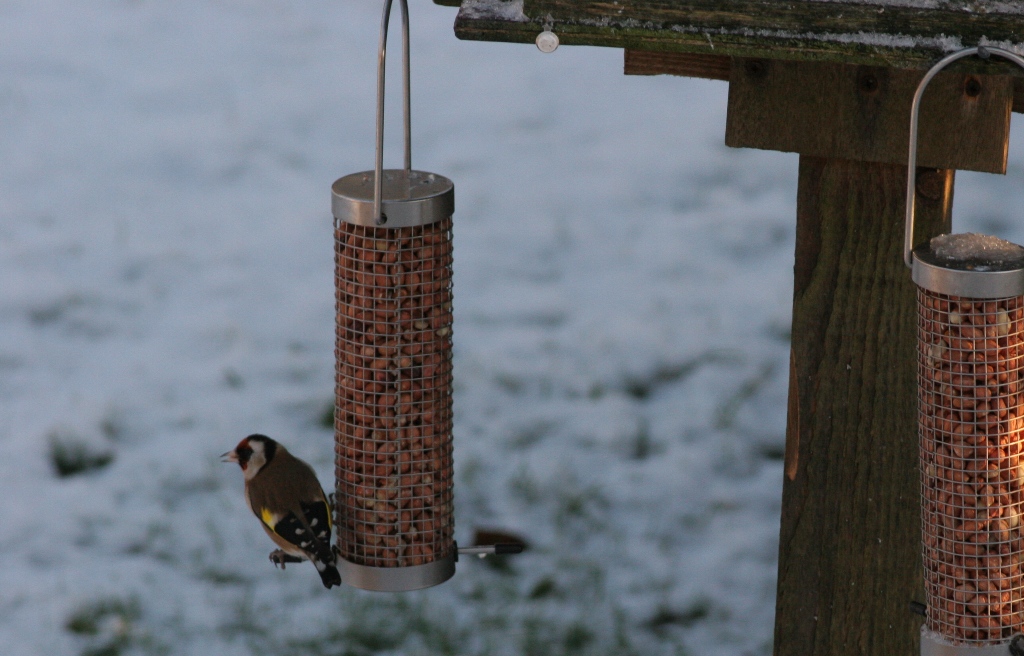
The Goldfinches had abandoned our garden for a while now, perhaps excluded by the very pushy crowd of hungry House sparrows - but they are back this morning.
Carl

Could this be the last day of hard frost?


The forecast is for the wind to pick up from the north-west and for the temperature to rise above freezing this evening.  I have a feeling the Highlanders will be quite pleased about that - there is probably only so much fun you can have eating frozen grass...  The lower shot is of a very frigid Loch Indaal taken from the Uiskentuie Strand.

Monday, 6 December 2010

Northern Sky - James Deane


Many thanks to James for this seriously classy shot taken from his upstairs window in Islay House Square. 

James used an exposure time of 20 minutes to capture the stars like this - using a very wide 10mm Sigma EX  lens on his Canon DSLR.  The Plough is on the right...


A light dusting of snow has continued to lie here in Port Charlotte - I understand it is heavier elsewhere.  The skies are clear however, and it will surely freeze if this remains the case.

The 'Flying Flock'


reception@swt.org.uk

Snow in Port Charlotte


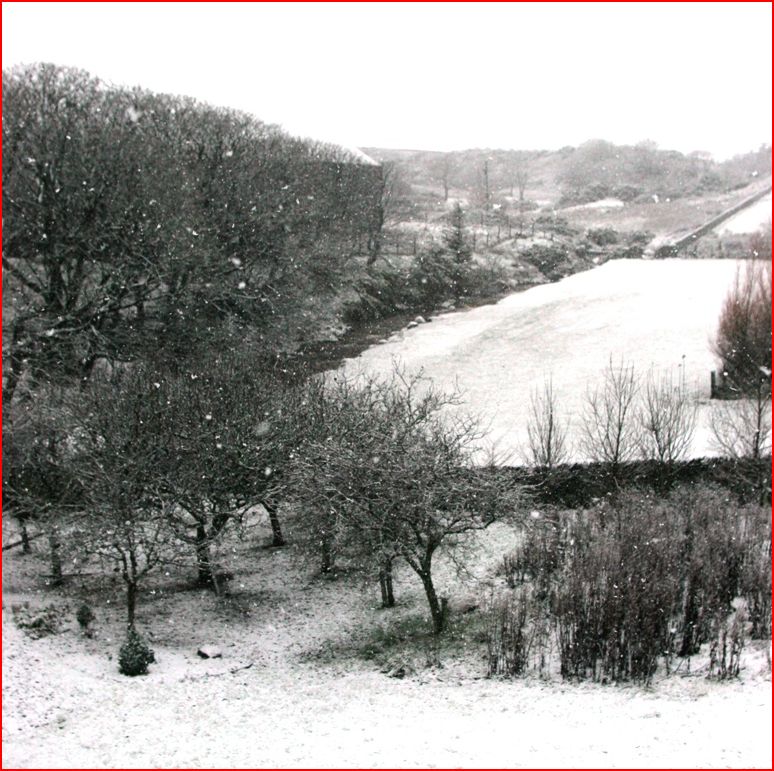
Suddenly we have snow.  Below the apple trees in the foreground, the blackbirds are trying to find sustenance by eating the windfalls.  I hear that traffic is at a standstill in Ballygrant and that conditions are difficult even in Bowmore.

Sunday, 5 December 2010

Red Throated Diver (Gavia stellata), Port Charlotte


Following the glorious morning, we took a walk along the coast north from Port Charlotte this afternoon, but the sunshine was not to continue.  A big black shower took away both the warmth and the light pretty much as soon as we had set off, although it never actually delivered anything.  We caught a glimpse of some Roe deer disappearing into the gorse, but not much else showed as the day gently ebbed away.  I spent a little bit of time mucking about with long exposure times on a stream with some bright yellow lichen-covered boulders, and this Red throated diver gave us a brief show as it hunted close along the shoreline.
Carl

Paps of Jura in the snow this morning


Cycled down to Port Askaig this morning in the most perfect weather imaginable for December, past fields studded with sparkling geese.  Only small amounts of slush on the roads - the Council boys had done a good job.  This must be THE classic shot of the Paps of Jura at the moment - I wonded how many people have snapped this view recently?  There was a flock of probably around thirty Golden Plover in the shoreside fields opposite Bry Bruaich farm, along with a scattering of Lapwings.
Carl

Friday, 3 December 2010

Fiona's Shells

Hard to believe, but yesterday, in glorius sunshine, Fiona MacGillivray was braving the freezing conditions on Kilnaughton Beach and came across a long-coveted treasure - a Slit Limpet (Emarginula fissura). Apparently she was jumping up and down for joy when she heard someone say 'Hello' just behind her! It was Mavis Gulliver who no doubt shared Fiona's enthusiasm - and little wonder; if you take a look at this website you'll see the limited distribution of this little beauty.

http://www.marlin.ac.uk/lzspeciesreview.php?speciesid=3259.

The shell can grow up to 10 mm long and 8 mm high and it says it's always white in colour, but maybe ours is a bit grubby! The arrow indicates the 'slit'. , the west might not hit the headlines when it comes to snow, but it sure is good for conchological specimens (that's shells to you and I!)


Yep

Fiona brought the specimen to the craft fair, together with her other finds and I was just as eager to see it - and now, to find my own! Thanks Fiona! Just look at this array of tiny beauties and tell me you don't fancy a bit of beach combing yourself!


Becky

The Shorefield Project.


The weather is truly horrible right now - a big cold southerly wind is carrying lots of sleet up the loch.  Yesterday suddenly seems a long time ago.  I had gone up to feed the Highlanders behind the Manse with James in the lovely sunshine - though the cattle probably did not think quite so highly of the weather.  The frost made it difficult to feed.  They get extra cake in these conditions - and run towards the pickup as soon as they catch sight of us. 
The two bullocks for the Shorefield Project are in the foreground in the picture above.  They have been sticking together since arriving.  Maybe we will get the opportunity to move them up to Octomore and dose them next week.  James has been too busy over the past days - the frost has made for extra work on the farm, and there has been a film crew at Bruichladdich distillery working on material for their new website.  James is very involved with that becasue of Dotty's Well - but that's another story for another day....


James then fed the heifers across the way before heading back up to the farmhouse with a big cask of hot water drawn from our flat- because all of his pipes had frozen.  The thaw has now set in.

Robin (Erithacus rubecula)


Took this rather nice shot of one of our local Robins while going up to feed the chickens yesterday.

Blackbird (Turdus merula) feeding on windfall apples


There is a veritable carpet of wind-blown apples in Sally's orchard - great food for the thrushes and there have been around twenty blackbirds eating away for quite a while now. 

How to help wildlife this winter - Advice from the Scottish Wildlife Trust

As snow and ice covers much of the country this week, the Scottish Wildlife Trust has issued an appeal to the public today asking everyone to help look after Scotland’s wildlife this winter by following some simple tips.

Simon Milne, the Scottish Wildlife Trust’s Chief Executive, said: “Heavy snow fall and plunging temperatures means that the ground is frozen and inaccessible. For ground-feeding birds such as dunnocks and thrushes, this prevents them accessing the invertebrates they usually rely on for food. Equally, frozen water bodies could prevent ducks, otters, water voles, and wading birds from feeding or behaving as normal. Small birds can find it tough to find berries in amongst snowy shrubs and larger birds and mammals will find it more difficult to hunt for prey.

“In these conditions, our wildlife could be restricted in their movements and food supplies could quickly dwindle as competition increases. You can help our wildlife by simply clearing areas of snow so that wildlife can access the ground underneath or by providing food for them which is similar to the food they would eat in the wild. Make sure feeders are free from snow and that they are placed at a safe height above the ground to avoid attacks from domestic animals.

“For birds use a variety of food types such as bird-seed mixtures, fat-balls, mealworms (adored by robins), fresh coconut or even mild grated cheese which is favoured by dunnocks. The greater the variety of food the greater will be the variety of birds you attract to your garden. Who knows you might even be rewarded by a visit from the brambling – a colourful winter visitor from Siberia and Scandinavia.

“Please avoid putting out mouldy or desiccated food, cooked porridge oats, milk or fat from cooking as these can be harmful to birds. And remember to put out a shallow bowl of water to enable our birdlife to access water in frozen conditions.

“On a more positive note, it’s not all bad for Scotland’s wildlife right now. Moles and voles and other underground creatures could be finding this weather quite cosy, as the snow will act as a layer of insulation and protects them from predators.

“Winter can also be a great time of year to see and hear wildlife. Look out for the tracks and signs in the snow and try and identify who made them, listen for Tawny owls as they start their noisy courtship, and if you get the chance visit a coastal or inland water wildlife reserve like Loch of the Lowes near Perthshire or our Montrose Basin Visitor Centre in Angus to see spectacular numbers of geese, ducks and swans.

The Scottish Wildlife Trust is a national charity made up of local representatives working on the ground to protect wildlife across the whole of Scotland. Scottish Wildlife Trust staff located in small communities across Scotland have also been reporting their observations of how Scotland’s wildlife is coping with the big freeze.

Robert Potter, Reserves Manager North East for the Scottish Wildlife Trust, said: “In the Scottish countryside spreading from Angus and Perthshire to the Highlands, care should be taken on outlying roads not only for your own safety but for the safety of wildlife. Many animals will be driven out of the hills, and nearer to towns, in their search for food during the current weather, and therefore you are more likely to come across them on roads. Some are even attracted to the salt we put on our roads”

Speaking on behalf of Saving Scotland’s Red Squirrels, a partnership project led by the Scottish Wildlife Trust, Tayside Project Officer Ken Neil said: “Red squirrels in Perthshire and Angus will be finding it difficult to keep well fed during this tremendous snowfall. So, if you are lucky enough to have them as visitors to your garden, please help make sure that they have plenty to eat. Peanuts (not salted or dry-roasted), hazelnuts or a branded squirrel mix will be welcome additions to put out with the bird food.”

Donna Mathieson, People and Wildlife Officer for the Scottish Wildlife Trust, added: “Kids in Scotland have had a whale of a time this week spending days off school sledging, building snowmen and having lots of fun. The animals in our garden, however, haven’t got it so easy. If you would like to help out wildlife on your ‘snow days’, why not fill up your bird feeder, or if you don’t have one, make one from an old water bottle! You can also get messy in the kitchen and make your own “bird cake” by mixing suet or lard with seeds, cheese, and dried fruit.”

Thursday, 2 December 2010

Loch Gorm

Not to be outdone in the winter wonderland photography stakes, here is Loch Gorm today.
Malcolm

Meanwhile, back on Islay . . .


Frozen Loch Indaal at 8.30 am today with the mussels and Mute Swans hanging on in there . . .

Becky

It's another world over there - pictures from George Robertson


Lord George Robertson (who wishes he was in Port Ellen right now...) has spent the last four days digging himself out of various situations over in Dunblane, and has sent us these pictures in response to our lovely crisp, clear, snow-free vistas.  Ah well.  Apparently we might be in for a few wee flurries ourselves over the next couple of days. 
Carl

Wednesday, 1 December 2010

Focus on the Wagtail


Definitely the most species I have managed to get in one shot on my lawn - or anywhere else for that matter.  You just have to focus on the Wagtail, or your eyes will go all funny....
Carl

Loch Indaal Lighthouse this morning

Paps of Jura and Brent Geese

Argyll and Bute Local Biodiversity Action Plan 2010- 2015 launched


A new blueprint for maintaining and improving biodiversity in Argyll and Bute was launched on November 30th.
The revised Argyll and Bute Local Biodiversity Action Plan (LBAP), overseen by the Argyll and Bute Local Biodiversity Partnership, takes over from the previous plan which was launched in 2001.
This latest phase of the local biodiversity process has attracted interest from organisations from across the UK who want to deliver projects in an area well known for its wealth of biodiversity.
And it will enable lead partners - including government and non-government agencies and community groups - to continue to work together to deliver biodiversity benefits throughout Argyll and Bute.
Among the significant achievements of the previous LBAP were influencing agricultural environment schemes, river basin and catchment management plans, protected marine and coastal habitats and species plans as well as encouraging people to be more proactive in their community.
The revised plan focuses on threatened habitats and species through adopting the ecosystem approach, which is a nationally accepted policy as a means of ensuring cohesive conservation activities.
There are six work programmes - Freshwater and Wetland, Marine and Coastal, Lowland and Farmland, Woodland, Upland and the Built Environment. Each contains a number of habitats and associated species of which projects will be developed to ensure their sustainability.
Local Biodiversity Partnership chairman, Councillor Bruce Marshall, said: “I am very proud of the hard work put in by the partners and RPS Consultants. Developing the 2010-2015 plan was not an easy task, and I congratulate all those who contributed to it.
“The newly revised plan has provided an opportunity for more organisations and communities to get involved. We are very proud of the way in which such a wide range of people have so far played a part, and look forward to even more becoming involved in the future. I know that some will be disappointed that their specialist area of interest may not have been included but this is an ever changing process which allows us to address these over time.
“As this is International Year of Biodiversity 2010, it is particularly fitting that we are at this stage. However, for the plan to be successful, it is essential that partners encourage the community to get involved in the work programmes relevant to their area. We are very lucky in Argyll and Bute to have the accolade of having some of the best examples of biodiversity in Britain, so let’s keep it that way.”

Guests at the launch heard a number of presentations, among them one from Lochgilphead High School pupils on their ‘Biodiversity through a Lens’ project. 
The revised plan was officially launched by Andrew Campbell, Scottish Natural Heritage’s operations manager for Argyll.
"Our local bird life is so well-known that birdwatching contributes significantly to the local economy of a lot of our islands,” he said.  “But our real diversity often lies in unexpected quarters. Argyll is one of the richest places on the planet for mosses, liverworts and lichens, with our west coast woodlands being a particular hotspot of world importance.”
The UK has 15% of all of Europe's flowering plants, but 65% of all of Europe's mosses and liverworts - most of which occur in Argyll and Bute.
Andrew went on: “Argyll and Bute is a very small component of Europe and is home to an equally small and very thinly spread human population, but all of us living here carry an awesome responsibility to look after some iconic species like otters, red squirrels, golden eagles, basking sharks and whales.
“Looking after the ecosystems on land and sea which are home to these and thousands of other species is a challenge to all of us and the biodiversity partnership represents a broad coalition of individuals and groups who are a joy to work with and who can be quite inspiring.
“All of us in Argyll and Bute are fortunate to have easy access to such an outstanding environment and the chance to enjoy the diversity of life around us. We all need to commit to the task of sustainably utilising it in our day to day lives.”

The Argyll and Bute Local Biodiversity Partnership was established in 1997, with the first edition of the Argyll and Bute Local Biodiversity Action Plan launched in 2001. The partnership has 30 members.

Argyll and Bute Biodiversity Partnership

Gatepost 3 or is it 4?

Well, folks, I know you've all been dying to see the next contender for Islay's best gateposts and naturally they all look better in this wonderful, 'blooming cold' weather that some of us actually like! So here it is - another lichen covered specimen with the added bonus of a wee tree in its centre! So much wildlife in such a tiny space!

Also some more ice on our Rhinns goosecounting round today - makes a change from wading through muddy fields!

Becky