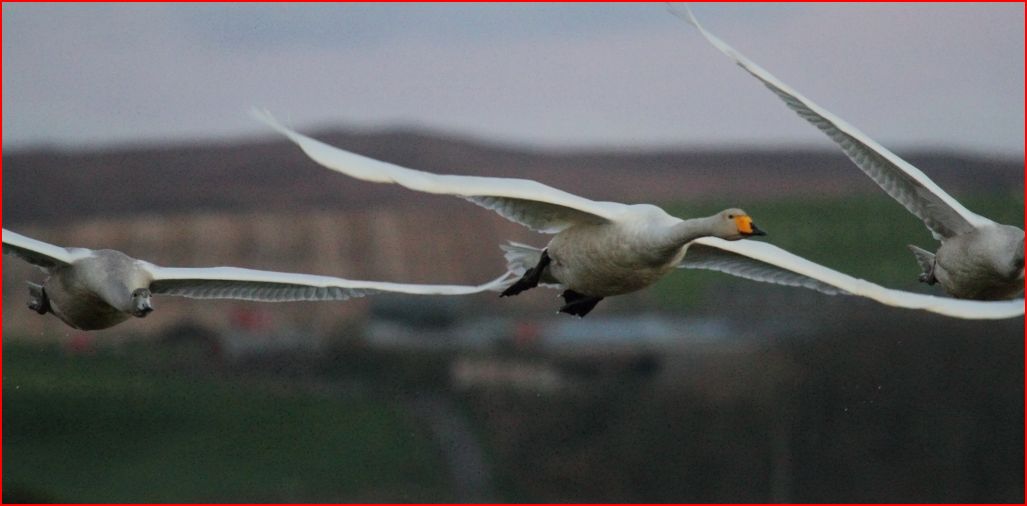
Although Cormorants can be seen in small numbers around Islay, for example in Loch Indaal, most of the year, to the best of my knowledge no-one has ever found them breeding. When we did a complete circumnavigation of Islay in 2000 counting all the seabirds on the cliffs and islands we failed to see a single Cormorant. Yet, every late summer, young birds appear in Loch Indaal so they can't be breeding that far away. Maybe there are a few pairs on one of the many skerries and islands off the south-east coast. They just need finding! The photograph is another one by Gordon Langsbury.
Malcolm
Monday, 24 January 2011
Sunday, 23 January 2011
Grey Herons
There are perhaps 20 to 30 pairs of Grey Herons breeding on Islay, with small colonies at Loch Allan, Sunderland and Kildalton, and some scattered pairs elsewhere. During the winter, and especially during cold weather when inland waters are frozen, the solitary herons can be seen feeding on the shore around Lochs Indaal and Gruinart and also in sheltered bays anywhere round the coast. This stunning photograph of a successful fisherman was taken by Gordon Langsbury.
Malcolm
Malcolm
Saturday, 22 January 2011
Is there another side to Loch Indaal?
One of the reasons I love where I live, overlooking Loch Indaal, is that the Loch has so many moods affected by the weather. One day the water in the Loch is angry and crashing against the rocks and shore and another it seems to suffer from inertia, where it can barely muster the energy to move. Such is today's mood, compounded by the fact that the boundary between loch and sky is invisible, shrouded as it is in a big stratus cloud which has not shifted all day. It is unusual not to be able to see the other side of the Loch all day, but I kind of like it because one can imagine a different world on the other side and it's nice to live on the edge of the unknown from time to time, even if one knows fine well that Bruichladdich and Uiskentuie and Port Charlotte are in fact still there, large as life.
Anyway, enough rambling. I wonder if the birds are thrown into confusion with all this stratus? Here's two photos of the same view. The top one taken today and the bottom one with its beautiful cumulus cloud taken around the same time several years ago.
Becky
Anyway, enough rambling. I wonder if the birds are thrown into confusion with all this stratus? Here's two photos of the same view. The top one taken today and the bottom one with its beautiful cumulus cloud taken around the same time several years ago.
Becky
Scaup
There's been a wintering flock of Scaup in Loch Indaal for as long as anyone has been keeping bird records. During the 1970s and 1980s, peak counts of up to 1500 were quite regular, but in recent years, numbers have been smaller with, this winter, not more than 380-400 during December, the usual peak month, when we had expected the cold weather to bring more. Reasons for the decline are unknown. They might be on the breeding grounds in Iceland, or changes in the amount of crustaceans and molluscs in Loch Indaal might be involved.
The flock is usually to be found well out in the loch, but occasionally they come close inshore as they did this week.
Malcolm
The flock is usually to be found well out in the loch, but occasionally they come close inshore as they did this week.
Malcolm
Friday, 21 January 2011
Fencepost - dead or alive?
Another interesting fencepost whilst goose counting. This one is near Ardbeg and has a bramble growing from within. I am told that up until last year it was definitely alive, but time will tell whether the poor thing has finally bitten the dust or not!
Becky
Goats
You can see feral goats in several parts of Islay, including, especially, The Oa, the Rinns, and the north coast. A census a few years ago found about 750 of which 400 were on The Oa. They are all descendants of goats which were once kept on farms not just for meat and milk but also because where farms included coastal cliffs, the goats were deliberately put into the cliff-top pastures in the hope that they would graze patches of grass down the cliffs and thus reduce the temptation for the sheep to do likewise. Goats are sufficiently sure-footed and agile to be able to do this without falling off. Sheep, on the other hand............!
Malcolm
Malcolm
![]() |
| Photo: Carl Reavey |
Thursday, 20 January 2011
Barnacle Geese and the full moon
It is often said that some human beings behave differently when there is a full moon. Well, there is plenty of precedent for that in the animal kingdom. Barnacle geese for example, usually feed during the day, flying in to roost at the top of Loch Indaal and at Loch Gruinart as the light fades, and then leaving again shortly after dawn. This all changes during the full moon however - and they roost up during the day and fly off to the fields to feed through the night. So there have been large numbers of Barnacles sitting on the Merse at the top of the loch today.
I wonder if anyone has ever done a study to determine how much light they need to trigger the change in behaviour pattern? Presumably there are advantages to feeding at night? Otherwise why would they bother?
Labels:
Barnacle Geese,
Full Moon,
Islay,
Loch Gruinart,
Loch Indaal
Full Moon over Loch Indaal
A full moon has just risen over Loch Indaal. It is very cold tonight - temperatures are well below freezing.
Lachlan Macquarie - The Father of Australia
Please forgive this slightly off-topic and quite shameless plug for a TV programme to be shown on BBC Scotland next Wednesday. Directed by my good friend Les Wilson, who has a house in Port Charlotte, it is narrated by David Tennant so should also appeal to all you Whooies out there... Macquarie was born on the island of Ulva.
Below is a link to the Caledonia TV website which has a video preview of the drama documentary.
Caledonia TV - Video Clip
Carl
Labels:
Australia,
Caledonia TV,
David Tennant,
Lachlan Macquarie,
Ulva
Port Ellen
Peat cutting
Labels:
flaughter spade,
Islay,
Peat cutting
Wednesday, 19 January 2011
Nave Island
This is a view of Nave Island from Ardnave Point. It's mainly a view of the blue sky above however, as I was enjoying that so much at the time. The shingle beach of the island is often crowded with seals and you can get great views from Ardnave, especially when the weather is as good as it was today. Walking round the Point this morning we saw well over 50 bird species, including all three types of Diver, and flocks of Purple Sandpiper and Grey Plover.
Mark
Mark
Otter tracks - Ardnave
Ardnave is one of the best places on the island to see Otters. That said, I spent hours there today and didn't see one, though the beaches were covered in tracks leading to and from the water
Mark
Mark
Clinging on
This young Sycamore tree is growing in a small quarry and what are probably at least half its roots are growing down the quarry face. The close up shows how some of them curl into cracks in the rocks while others have fused - perhaps giving them extra strength. Photographed yesterday in glorious January sunshine!
Malcolm
Malcolm
Tuesday, 18 January 2011
Herring fishing on Islay
![]() |
| Photo: Archibald Cameron. The Museum of Islay Life |
We have posted about peat cutting on Islay recently, and this shows peat stacks outside workers cottages at Tayvullin, up near Ardnave. Tayvullin is now abandoned (although one cottage has recently been renovated as a holiday home). What you see in the background are the fish processing factories that grew up around the herring industry. While herring fishing on Islay was never undertaken on the same scale as it was in other West coast and island communities, you can see that there was a significant effort made.
The herring were fished out during the early years of the 20th century - and all the buildings in the background disappeared. It is still possible to see some of their concrete foundations - nothing more. One of the cottages in the foreground is still there. It served as a cowshed for many years, but it has now been re-roofed and properly organised as a nest site for Choughs. Ardnave is one of the best places on Islay to see our iconic Corvids.
| Adult Chough with newly fledged young |
Labels:
Ardnave,
Chough,
Herring fishing,
Islay,
Tayvullin
People with fish on Bowmore Pier
I thought it would be good to put some old photographs from Islay up on the blog. This is quite a well known shot of a group showing off their catch on Bowmore pier. Most of the fish appear to be flatfish - good sized plaice probably. You can just see a man in a skiff behind the group to the left of the photograph. There is another skiff drawn up on the slip. The surface of the pier appears to have been wooden in those days.
You will notice that very few of the children are wearing shoes.
I have heard of people trying to catch white fish in Loch Indaal in the recent past, but have never heard of anyone being successful with anything apart from puchie (Saithe or Coalfish Pollachius virens) and Lythe (Pollock Pollachius pollachius). I have never heard of anyone catching significant numbers of flatfish in recent years - which is probably a legacy of over zealous trawling.
Photo is from the Museum of Islay Life
Monday, 17 January 2011
Sunday, 16 January 2011
Bridgend Woods
| The woods stretch all the way to Port Askaig, basically following the course of the River Sorn. They border some of Islay's best agricultural land |
| The trees represent a valuable resource for the estate - and they are managed for timber. |
| The snowdrops are almost with us. I believe that Bridgend Woods have one of the largest displays of snowdrops anywhere in the UK. Another week and they will be spectacular. |
Labels:
Bridgend Woods,
Islay,
Snowdrops
Saturday, 15 January 2011
Scoping out a peat bank at Bolsay
| It was pouring with rain this morning - conditions that James and Duncan considered perfect for going up on to the moss at Bolsay to decide on a new peat bank that they propose to open up this year. |
| The going was quite hard for a while - we checked out a few possibilities but they were all rejected - usually because it would have been difficult to get the peats off the moss. |
| The ground was reasonably firm in places, but is traversed by some very wet bits. Tractors have been lost here. "The bigger the tractor the further down they go", I was cheerfully told... |
| We eventually found somewhere suitable. A couple of bridges will have to be built - using pipes topped with quarry waste - before a tractor could be brought on. |
Carl
Chough Shed
A few years ago now, SNH, in conjunction with local farmers, erected a number of wooden sheds in places around Islay where it was thought that Choughs might be a bit short of nest sites. Choughs are 'naturally' cave nesters, but have adapted to use old buildings on Islay. In recent years, the number of suitable buildings has fallen - not least because many of the old properties have been refurbished - and are no longer suitable for Choughs... Hence the Chough shed idea.
This one is at Bolsay - on Bob Paget's croft. They provide useful shelter for animals, potential storage for the farmer, and have these platforms built into the rafters which make ideal Chough nest sites. I don't know if Choughs have taken advantage of this one yet - although there are signs of Swallows having been here last summer.
What happened last night? Was it an earth tremor?
At around 22.45hrs last night lots of people heard/felt something on Islay - but there are no reports of an earth tremor on the net, not that we have been able to find anyway. Some people describe 'feeling' something, others heard a loud noise/rumble.
Does anyone know what it was? Suggestions include an earth tremor, explosion, thunder, a strong gust of wind - or an aircraft breaking the sound barrier. We once heard the Space Shuttle coming in to land at Edwards Air Force Base in California and when it passed overhead in the San Fernando Valley it made a similar (actually louder) noise...
Carl
*
Friday, 14 January 2011
The fields of yesterday - More photographs from Walter Rintoul
This is a croft at Glenegedale, I believe it belonged to Peter Reid.
These are fields on the Mull of Oa, with what I believe are haystacks (rather than cornstacks).
Walking on the Mull of Oa
The village of Keills on Jura. I would suggest that they are cornstacks, but could be wrong...
These are fields on the Mull of Oa, with what I believe are haystacks (rather than cornstacks).
Walking on the Mull of Oa
The village of Keills on Jura. I would suggest that they are cornstacks, but could be wrong...
Labels:
cornstacks,
DFG Photography,
haystacks,
Islay,
Jura,
Oa,
Walter Rintoul
Thursday, 13 January 2011
Subscribe to:
Posts (Atom)