The daffodils in Bridgend Woods were shining pretty well yesterday even on a fairly dreich day.
Malcolm
Sunday, 16 March 2014
Thursday, 13 March 2014
A bad attack of measles!
A large field at Foreland was planted with young trees last year, a mixture of broadleaved and coniferous, as part of a carbon sequestration project. While the trees are small, they require weeding. This was initially done by hand and now a weed-retardant spray has been applied making the field appear as if it is suffering from a nasty disease!
Malcolm
Malcolm
Tuesday, 11 March 2014
Saturday, 8 March 2014
A Celebration of Fenceposts
What better way to celebrate the good news that the INHT can stay put, at least for another couple of years, than to post some posts?!! A few weeks ago I walked across the daunting terrain of Duich Moss and found - well, that it wasn't so daunting after all! Admittedly I didn't wander across to the pools in the centre, but it was still unchartered terrain (as far as I'm concerned anyway) and territory I'd coveted for many years. I wandered cautiously onto the Moss from the 'high' road near Torra and walked parallel to Islay's most beautiful fence (remember I've seen quite a few with which to make comparisons!) I must have photographed nearly every fencepost - each one exquisitely adorned with a bounty of lichen and moss. Here is the first set of photos.
Becky
Becky
Friday, 7 March 2014
And the Natural History Trust is........
........staying where it is!
The Trust's lease with the Scottish Youth Hostels Association (SYHA) for its Natural History Centre in Port Charlotte ended last summer. The very generous terms of £25/annum for 21 years has greatly helped the Trust over the years, but all good things come to an end, and although the SYHA were prepared for us to stay on for at least two more years, they wanted a much more realistic rent of £1000 a year. The Trustees and Committee reluctantly decided we could not afford this and so announced to our members that we would be closing the Centre and would continue to look for another building (which we have been doing for the last two years without success), or perhaps have a mobile centre - a trailer which could also be a classroom.
Anyway, last week, discussions took place with Bruichladdich Distillery who have offered to sponsor the Trust for a period of two years, thus
enabling the Trust to continue to operate its Centre instead of having to pack up and leave. SYHA have agreed to
draw up a new lease for the Trust covering the next two years, during which negotiations
will take place between them and Bruichladdich Distillery. The latter have some as yet unformed ideas
about a public display area, possibly relating to the history of distillation
on Islay, and/or possibly relating to The Botanist, the distillery’s Islay dry
gin. The use of so many native Islay wild flowers in the gin makes an obvious
synergy with the Trust’s work on displaying information about Islay’s fauna and
flora and its maintenance of a database of natural history records. There is at
this point no commitment by either party beyond the two-year sponsorship.
The Natural
History Trust are extremely grateful to Bruichladdich Distillery for their sponsorship.
Details of this summer’s opening period and hours, and also of other
activities, like natural history rambles and family activities, will appear in
due course.
Sunday, 16 February 2014
Persecution of raptors in Scotland
Please go here:
http://www.birdingodyssey.blogspot.co.uk/
And please read what Islay resident, John Armitage, has written in the last three days, and then sign the online petition.
Thank you.
http://www.birdingodyssey.blogspot.co.uk/
And please read what Islay resident, John Armitage, has written in the last three days, and then sign the online petition.
Thank you.
Thursday, 6 February 2014
Geese and my dog
I was trying to get my labrador to be as interested in geese as I am, but he was keener on the different smells in the field. The whitefronts (and one Barnacle) were not that bothered by him, nor by me in full view only about 30 yards away.
Malcolm
Malcolm
Labels:
dog,
Greenland white-fronted goose
Tuesday, 28 January 2014
Wednesday, 22 January 2014
Friday, 17 January 2014
Lichens in the sun
We've not had many sunny days recently, but here is a lichen-covered willow positively glowing in the sunshine.
Malcolm
Malcolm
Monday, 6 January 2014
Wild flowers in 2013
After the usual start to the year with the carpets of snowdrops decorating Bridgend Woods, the cold spring delayed a great many flowering plants so that, when the BSBI (Botanical Society of Britain and Ireland) held their annual Scottish recording week on the island for the first time, and had chosen the second week of June as a good time of year to come, it turned out to be probably about two weeks earlier than would have been optimal. However, whereas I usually require a flower to be fully out to help me identify it, the experts included in the visiting dozen botanists seemed just as happy with buds or even just leaves! Assisted by generally very good weather, planned visits to under-recorded parts of the island went very well and, later in the year, I was sent a spreadsheet containing a magnificent 7,949 records which represented an increase in total wild flower records for the island of just over 20%!
The highlights of the year were undoubtedly the orchids, most of which flowered in much greater abundance than usual, especially the Greater and Lesser Butterfly and the Marsh Helleborine. The very rare Narrow-leaved Helleborine also had one of its better years, with 15 spikes, the most since the small scattered colony was first found in 1998.
Malcolm
The highlights of the year were undoubtedly the orchids, most of which flowered in much greater abundance than usual, especially the Greater and Lesser Butterfly and the Marsh Helleborine. The very rare Narrow-leaved Helleborine also had one of its better years, with 15 spikes, the most since the small scattered colony was first found in 1998.
Malcolm
![]() |
| Pyramidal Orchid |
![]() |
| Greater Butterfly Orchid |
![]() |
| Lesser Butterfly Orchid |
![]() |
| Marsh Helleborine |
![]() |
| Narrow-leaved Helleborine |
Wednesday, 1 January 2014
Moths in 2013
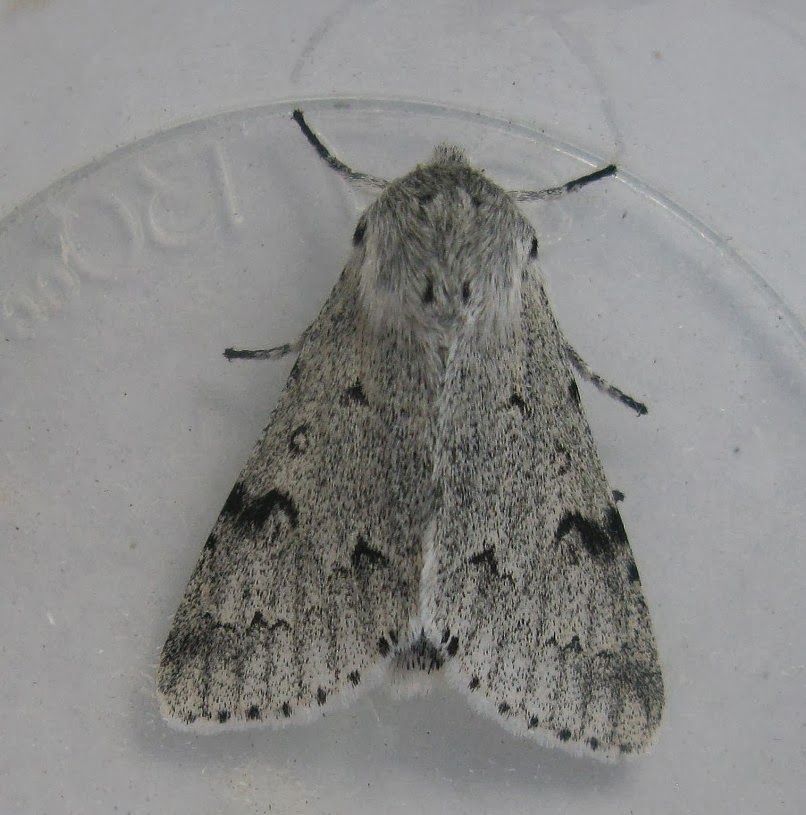
After a very poor year for moths in 2012, the year just ended was *much* better. My own garden total was 2,934 moths of 124 different species from 59 trapping nights. Last year's figures were 1,034, 101 and 52, respectively. My 2013 total included two new moths for Islay - the Miller (see photo) and one of those pesky little micros which the very kind and knowledgeable Danny Arnold, who is a regular visitor to Islay, identified for me. He also identified a new micro for Islay caught by Becky Williamson, who traps in Bowmore, and another caught by Dave Wood, who traps on the RSPB's Oa reserve.
It will be, as always, interesting to see what the coming year will bring. In the meantime, a very Happy New Year to everyone who reads our blog.
Malcolm
It will be, as always, interesting to see what the coming year will bring. In the meantime, a very Happy New Year to everyone who reads our blog.
Malcolm
Monday, 30 December 2013
Glaucous Gull
This first-winter Glaucous Gull turned up yesterday on the grass strip between the road and shore immediately outside my house. This got covered in debris in the storm on Tuesday last week and the bird spends its time pecking through it. They are irregular visitors here from the arctic - breeding in Iceland, Svalbard and arctic Russia. Some winters we only get one or two (as this winter, so far) but in January 2012 there were an exceptional 25–30 present on the island.
Malcolm
Malcolm
Sunday, 29 December 2013
Scaup
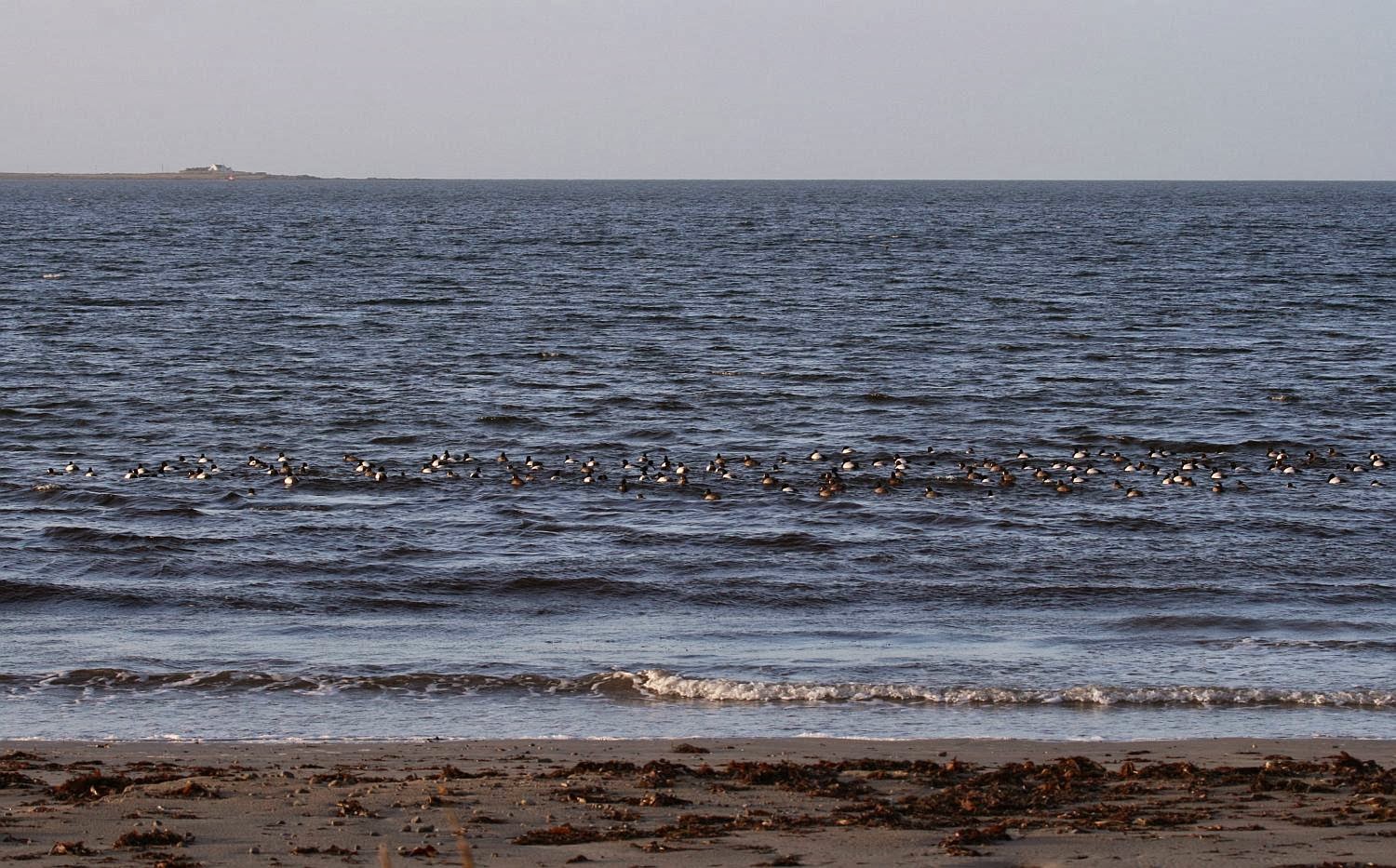
The wintering Scaup flock spends most of its time somewhere out in the middle of the loch between Blackrock and Bowmore, but every so often some of them come close to shore, as here.
Malcolm
Friday, 27 December 2013
Chough
Yesterday, the wind dropped to nothing, the sun came out, and here's a Chough enjoying life, as usual.
Malcolm
Malcolm
Wednesday, 25 December 2013
Happy Christmas!
A Happy Christmas to our readers and many thanks for following us. We hope you enjoy what we offer you here about Islay's fabulous natural history, even though the flow of new posts has been somewhat intermittent of late.
This was the view from our house this morning shortly before 9.00 am. The gale to storm force winds of recent days have veered from S to W and so the sea outside looks almost calm when looking east, as here, whereas yesterday the waves were washing debris across the road in a number of places round the loch.
And if you want some natural history, spot the two gulls!
Malcolm
This was the view from our house this morning shortly before 9.00 am. The gale to storm force winds of recent days have veered from S to W and so the sea outside looks almost calm when looking east, as here, whereas yesterday the waves were washing debris across the road in a number of places round the loch.
And if you want some natural history, spot the two gulls!
Malcolm
Labels:
Cloud formation,
Happy Christmas
Tuesday, 24 December 2013
New species for Islay
Last Saturday, a new species of mammal was seen on Islay.
It was all down to Mary Redman (leading the sleigh) who spent two years working with the Cairngorm herd and, now resident on Islay and working for the RSPB, had this inspired idea to bring a group of them, plus, of course, Father Christmas, to Islay, which meant carrying out some serious fund-raising. Every Christmas, several towns are visited like this across Britain, but rarely the islands. The stormy weather of the last week or two relented sufficiently to allow the six reindeer and their handlers to arrive and depart as arranged. The parade through Bowmore was attended by thousands (well, hundreds) of excited children and their parents.
Thank you, Mary.
Malcolm
(photo credit: http://dowerhouseislay.blogspot.co.uk)
It was all down to Mary Redman (leading the sleigh) who spent two years working with the Cairngorm herd and, now resident on Islay and working for the RSPB, had this inspired idea to bring a group of them, plus, of course, Father Christmas, to Islay, which meant carrying out some serious fund-raising. Every Christmas, several towns are visited like this across Britain, but rarely the islands. The stormy weather of the last week or two relented sufficiently to allow the six reindeer and their handlers to arrive and depart as arranged. The parade through Bowmore was attended by thousands (well, hundreds) of excited children and their parents.
Thank you, Mary.
Malcolm
(photo credit: http://dowerhouseislay.blogspot.co.uk)
Tuesday, 17 December 2013
Dead dolphin
Another dead cetacean was spotted this morning on the beach near Carnain, Loch Indaal, by Grant Carmichael who lives close by. He phoned SNH who phoned me. I was out goose counting round Loch Gorm at the time and was able to find it on my way back to Bowmore and do the necessary. This time it was a Common Dolphin, dead well before it washed up here. The winds have been strong and more or less southerly the last few days so it could have travelled some distance before coming into the loch. It isn't a very pretty sight, but here are the photos nonetheless as they show the salient features of this species with its well-toothed jaws in a longish beak, curved white side patches and a fairly small dorsal fin. It was just under 6 foot long (181 cm). I collected a sample of skin and blubber and am sending it off to the Scottish Marine Stranding Scheme where they will be able to test it for pollutants and also obtain the DNA to add to their databank and compare it with others of the same species.
Malcolm
Malcolm
Thursday, 12 December 2013
Colin Bradshaw on Islay
![]() |
| Redwing |
Labels:
BBRC,
Colin Bradshaw,
Greenland white-fronted goose,
Redwing
Wednesday, 11 December 2013
Gorse in winter
The bright yellow flowers of gorse make one of the few splashes of colour here at the moment, and raises the question of why bloom in winter when there can't be many, if any, insects around to fertilise the flowers. The answer seems to be that, when there are no insects, the gorse is capable of self-fertilisation, which is a pretty good strategy for having a prolonged flowering season. I've also seen it suggested that this is a good time to gather the flowers to make gorse wine or cordial, as you won't have to spend time trying to remove the tiny flies and beetles seeking the nectar inside the flowers!
Malcolm
Malcolm
Subscribe to:
Posts (Atom)