Or at least the snowdrops are coming out!
Malcolm
Wednesday, 22 January 2014
Friday, 17 January 2014
Lichens in the sun
We've not had many sunny days recently, but here is a lichen-covered willow positively glowing in the sunshine.
Malcolm
Malcolm
Monday, 6 January 2014
Wild flowers in 2013
After the usual start to the year with the carpets of snowdrops decorating Bridgend Woods, the cold spring delayed a great many flowering plants so that, when the BSBI (Botanical Society of Britain and Ireland) held their annual Scottish recording week on the island for the first time, and had chosen the second week of June as a good time of year to come, it turned out to be probably about two weeks earlier than would have been optimal. However, whereas I usually require a flower to be fully out to help me identify it, the experts included in the visiting dozen botanists seemed just as happy with buds or even just leaves! Assisted by generally very good weather, planned visits to under-recorded parts of the island went very well and, later in the year, I was sent a spreadsheet containing a magnificent 7,949 records which represented an increase in total wild flower records for the island of just over 20%!
The highlights of the year were undoubtedly the orchids, most of which flowered in much greater abundance than usual, especially the Greater and Lesser Butterfly and the Marsh Helleborine. The very rare Narrow-leaved Helleborine also had one of its better years, with 15 spikes, the most since the small scattered colony was first found in 1998.
Malcolm
The highlights of the year were undoubtedly the orchids, most of which flowered in much greater abundance than usual, especially the Greater and Lesser Butterfly and the Marsh Helleborine. The very rare Narrow-leaved Helleborine also had one of its better years, with 15 spikes, the most since the small scattered colony was first found in 1998.
Malcolm
![]() |
| Pyramidal Orchid |
![]() |
| Greater Butterfly Orchid |
![]() |
| Lesser Butterfly Orchid |
![]() |
| Marsh Helleborine |
![]() |
| Narrow-leaved Helleborine |
Wednesday, 1 January 2014
Moths in 2013
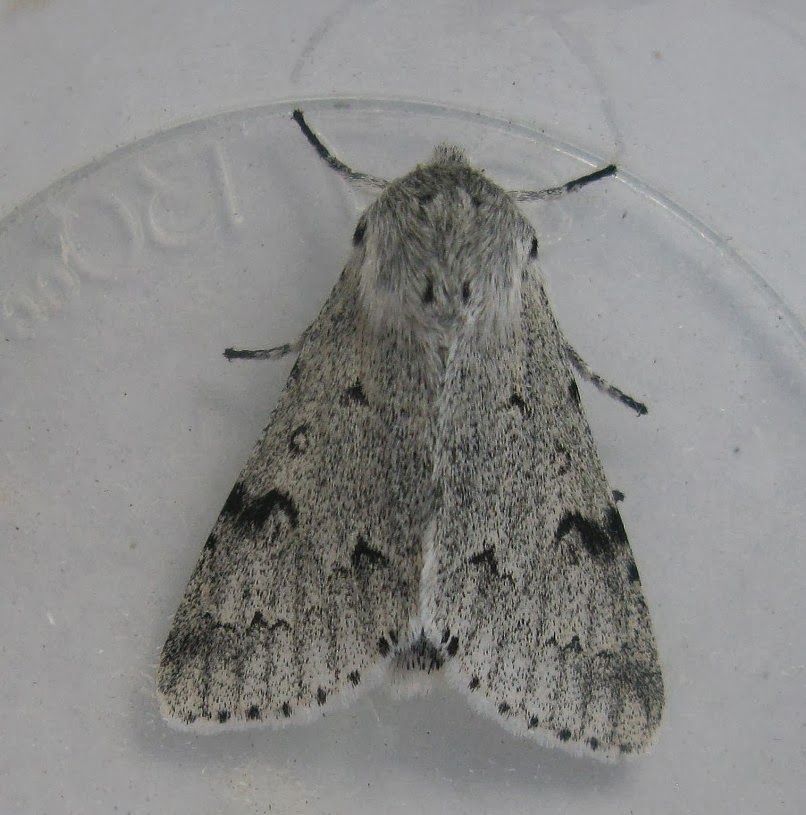
After a very poor year for moths in 2012, the year just ended was *much* better. My own garden total was 2,934 moths of 124 different species from 59 trapping nights. Last year's figures were 1,034, 101 and 52, respectively. My 2013 total included two new moths for Islay - the Miller (see photo) and one of those pesky little micros which the very kind and knowledgeable Danny Arnold, who is a regular visitor to Islay, identified for me. He also identified a new micro for Islay caught by Becky Williamson, who traps in Bowmore, and another caught by Dave Wood, who traps on the RSPB's Oa reserve.
It will be, as always, interesting to see what the coming year will bring. In the meantime, a very Happy New Year to everyone who reads our blog.
Malcolm
It will be, as always, interesting to see what the coming year will bring. In the meantime, a very Happy New Year to everyone who reads our blog.
Malcolm
Monday, 30 December 2013
Glaucous Gull
This first-winter Glaucous Gull turned up yesterday on the grass strip between the road and shore immediately outside my house. This got covered in debris in the storm on Tuesday last week and the bird spends its time pecking through it. They are irregular visitors here from the arctic - breeding in Iceland, Svalbard and arctic Russia. Some winters we only get one or two (as this winter, so far) but in January 2012 there were an exceptional 25–30 present on the island.
Malcolm
Malcolm
Sunday, 29 December 2013
Scaup
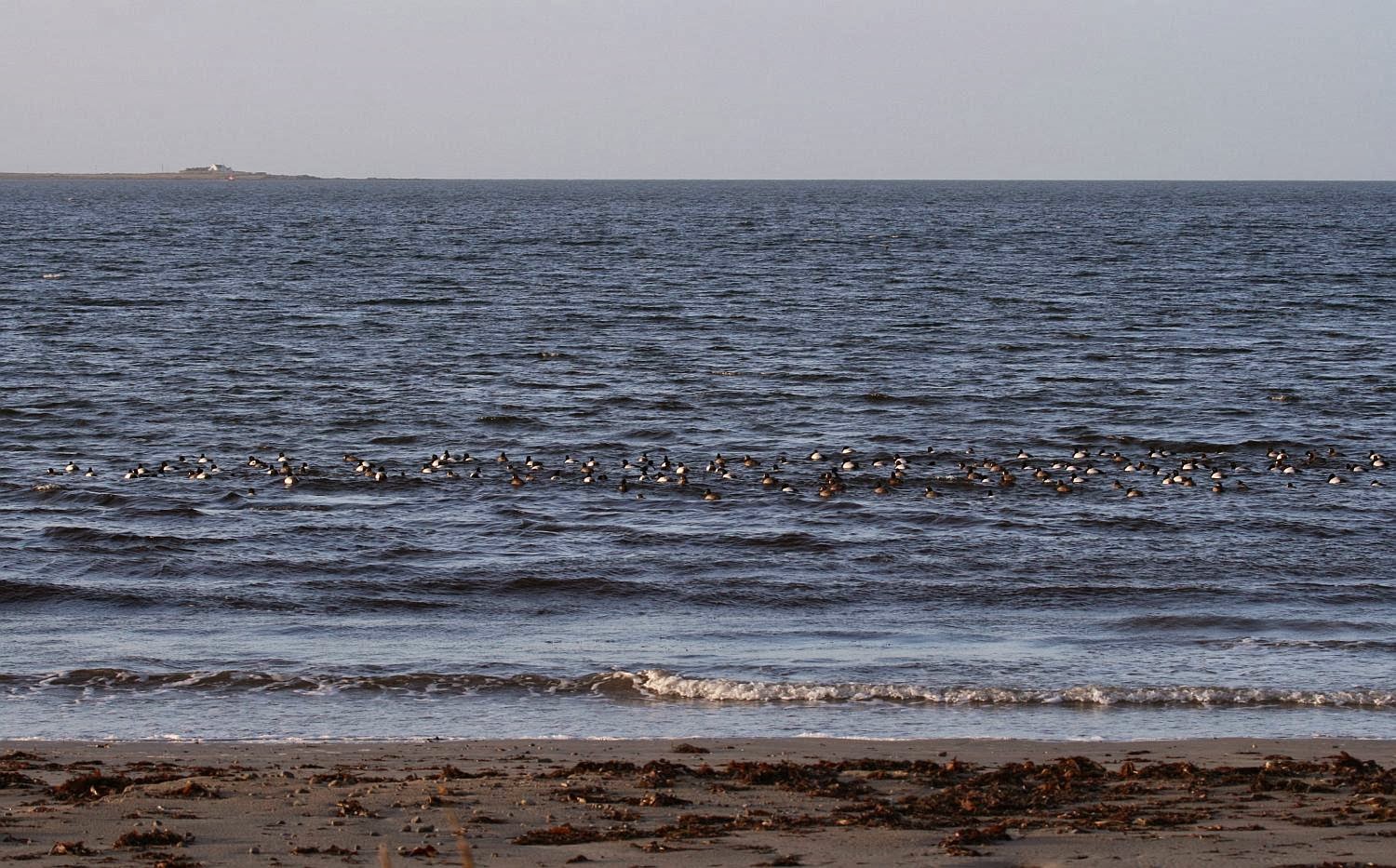
The wintering Scaup flock spends most of its time somewhere out in the middle of the loch between Blackrock and Bowmore, but every so often some of them come close to shore, as here.
Malcolm
Friday, 27 December 2013
Chough
Yesterday, the wind dropped to nothing, the sun came out, and here's a Chough enjoying life, as usual.
Malcolm
Malcolm
Wednesday, 25 December 2013
Happy Christmas!
A Happy Christmas to our readers and many thanks for following us. We hope you enjoy what we offer you here about Islay's fabulous natural history, even though the flow of new posts has been somewhat intermittent of late.
This was the view from our house this morning shortly before 9.00 am. The gale to storm force winds of recent days have veered from S to W and so the sea outside looks almost calm when looking east, as here, whereas yesterday the waves were washing debris across the road in a number of places round the loch.
And if you want some natural history, spot the two gulls!
Malcolm
This was the view from our house this morning shortly before 9.00 am. The gale to storm force winds of recent days have veered from S to W and so the sea outside looks almost calm when looking east, as here, whereas yesterday the waves were washing debris across the road in a number of places round the loch.
And if you want some natural history, spot the two gulls!
Malcolm
Labels:
Cloud formation,
Happy Christmas
Tuesday, 24 December 2013
New species for Islay
Last Saturday, a new species of mammal was seen on Islay.
It was all down to Mary Redman (leading the sleigh) who spent two years working with the Cairngorm herd and, now resident on Islay and working for the RSPB, had this inspired idea to bring a group of them, plus, of course, Father Christmas, to Islay, which meant carrying out some serious fund-raising. Every Christmas, several towns are visited like this across Britain, but rarely the islands. The stormy weather of the last week or two relented sufficiently to allow the six reindeer and their handlers to arrive and depart as arranged. The parade through Bowmore was attended by thousands (well, hundreds) of excited children and their parents.
Thank you, Mary.
Malcolm
(photo credit: http://dowerhouseislay.blogspot.co.uk)
It was all down to Mary Redman (leading the sleigh) who spent two years working with the Cairngorm herd and, now resident on Islay and working for the RSPB, had this inspired idea to bring a group of them, plus, of course, Father Christmas, to Islay, which meant carrying out some serious fund-raising. Every Christmas, several towns are visited like this across Britain, but rarely the islands. The stormy weather of the last week or two relented sufficiently to allow the six reindeer and their handlers to arrive and depart as arranged. The parade through Bowmore was attended by thousands (well, hundreds) of excited children and their parents.
Thank you, Mary.
Malcolm
(photo credit: http://dowerhouseislay.blogspot.co.uk)
Tuesday, 17 December 2013
Dead dolphin
Another dead cetacean was spotted this morning on the beach near Carnain, Loch Indaal, by Grant Carmichael who lives close by. He phoned SNH who phoned me. I was out goose counting round Loch Gorm at the time and was able to find it on my way back to Bowmore and do the necessary. This time it was a Common Dolphin, dead well before it washed up here. The winds have been strong and more or less southerly the last few days so it could have travelled some distance before coming into the loch. It isn't a very pretty sight, but here are the photos nonetheless as they show the salient features of this species with its well-toothed jaws in a longish beak, curved white side patches and a fairly small dorsal fin. It was just under 6 foot long (181 cm). I collected a sample of skin and blubber and am sending it off to the Scottish Marine Stranding Scheme where they will be able to test it for pollutants and also obtain the DNA to add to their databank and compare it with others of the same species.
Malcolm
Malcolm
Thursday, 12 December 2013
Colin Bradshaw on Islay
![]() |
| Redwing |
Labels:
BBRC,
Colin Bradshaw,
Greenland white-fronted goose,
Redwing
Wednesday, 11 December 2013
Gorse in winter
The bright yellow flowers of gorse make one of the few splashes of colour here at the moment, and raises the question of why bloom in winter when there can't be many, if any, insects around to fertilise the flowers. The answer seems to be that, when there are no insects, the gorse is capable of self-fertilisation, which is a pretty good strategy for having a prolonged flowering season. I've also seen it suggested that this is a good time to gather the flowers to make gorse wine or cordial, as you won't have to spend time trying to remove the tiny flies and beetles seeking the nectar inside the flowers!
Malcolm
Malcolm
Monday, 9 December 2013
Dead Pilot Whale
A very, very dead Long-finned Pilot Whale was washed up on the beach near Uiskentuie Farm in the last 24 hours. It wasn't there yesterday morning, and I only discovered it this afternoon because I was driving past and saw a local council worker with digger and trailer ready to take it to the council waste disposal site. It had clearly died a considerable time ago as bones were showing and the belly was split completely open. I will spare you a sight of that, and so have appended this photograph of just its head, with the characteristic bulging forehead and stubby teeth in both jaws. I'm not sure when the last one was found on an Islay beach, but this is the species which gets reported every so often for the mass strandings of live animals. Fortunately, we've never had such an occurrence. The last one was in September 2012 near Anstruther, Fife, when 22 animals came ashore and died.
Malcolm
Malcolm
Sunday, 8 December 2013
Sunday, 1 December 2013
Sleeping geese
During the last full moon, there were several clear nights and the Barnacles were out feeding in the fields. They then spend the daytime snoozing on the mudflats at Bridgend and at Loch Gruinart. It makes them quite easy to count, though one has to take care not to count their reflections, too!
Malcolm
Malcolm
Labels:
Barnacle Geese,
Bridgend flats,
roosting
Thursday, 28 November 2013
The Paps of Jura
The three Paps, from left to right, Beinn Chaolais, Beinn an Oir and Beinn Shiantaidh. From most of Islay, only two of them are properly visible, Beinn an Oir, the tallest of the three, being hidden behind Beinn Chaolais.
Malcolm
Malcolm
Wednesday, 27 November 2013
Tuesday, 19 November 2013
December Moth in November, again!
Three years ago, almost to the day, I caught my first December Moth. This week, I caught my second. I have yet to catch a November Moth, but live in hopes. However, it is probably now too late in the year as the November Moth mainly flies in September and October, whereas the December Moth flies from about October to January. Perhaps they need renaming!
Malcolm
Malcolm
Sunday, 17 November 2013
Wildlife Explorer of the Year 2013
A broken PC and wet weather has meant no postings from me for a while, but I was determined to get this on the blog as it is so well-deserved (and overdue!) Congratulations to Ellen Bielinski of Dumfries-shire who is this year's Wildlife Explorer of the year. Here she is sporting her new T-shirt. To earn this place, Ellen completed many taxing quizzes at the Visitor Centre this summer. Her name was put into a draw with the others who took part and she was the fortunate winner. Well done to all who entered - and a special well done to Ellen!
Becky
Becky
Saturday, 16 November 2013
Islay from the air
With apologies for the long silence here, posting will now resume, though quite how frequently will have to be seen.
I've always been fascinated by looking down on Islay from above, and here are a couple of photographs taken on a recent flight showing part of the Machrie Golf Course and the airport. The conservationist in me wonders what was destroyed when that area of dunes was turned into a golf course back in 1891. On the other hand, there are still plenty of unmanaged areas full of wild flowers and butterflies in the summer, while the Barnacle Geese like the mown areas in the winter!
The airport clearly shows its original layout of three intersecting runways as constructed in the early years of the Second World War, but only the main (1,545 metres) north-west to south-east runway (across the picture from left to right) and part (635 metres) of the approximately east-west runway are now in use.
Malcolm
I've always been fascinated by looking down on Islay from above, and here are a couple of photographs taken on a recent flight showing part of the Machrie Golf Course and the airport. The conservationist in me wonders what was destroyed when that area of dunes was turned into a golf course back in 1891. On the other hand, there are still plenty of unmanaged areas full of wild flowers and butterflies in the summer, while the Barnacle Geese like the mown areas in the winter!
The airport clearly shows its original layout of three intersecting runways as constructed in the early years of the Second World War, but only the main (1,545 metres) north-west to south-east runway (across the picture from left to right) and part (635 metres) of the approximately east-west runway are now in use.
Malcolm
Labels:
Islay Airport,
Machrie Golf Course
Subscribe to:
Posts (Atom)