Friday, 1 July 2011

Flora and fauna Kintra 1st July

We had six on today's walk at Kintra and I think it was the best weather we've yet had for our rambles and I was encouraged to see more butterflies about. Amongst our ramblers were an amateur geologist who reinforced some of the things Alistair talked about a few weeks ago and some members of Rochdale Natural History Society who have been moth trapping whilst they've been here. I was delighted to find interested ears for the abundance of lichen we saw! Thanks everyone. Here's the list. Please let me know if I've left anything out. Carl, we need your dictaphone!
Becky

BIRDS
Common Gull, Herring Gull, Great Black-backed Gull, Chough, Hooded Crow, Pied Wagtail, Arctic Tern, Cormorant, Eider, Oystercatcher, Snipe, Common Sandpiper, Song Thrush, Redpoll, Chaffinch, Fulmar, Great Northern Diver, Raven, Meadow Pipit, Sand Martin, Swallow, Wheatear, Rock Dove, Starling

FLORA
Bird’s-foot Trefoil, Meadow Buttercup, Bulbous Buttercup, Creeping Buttercup?, Forget-me-not sp., Lady’s Bedstraw, Marsh Marigold, Silverweed, Germander Speedwell,White Clover, Mouse-ear sp.,(Common)  Heath-spotted Orchid, Eyebright, Marsh Thistle, Spear Thistle, Creeping Thistle, Lousewort, Cuckoo Flower, Lesser Spearwort, Ragged Robin, Cat’s-ear, Common Cottongrass, Tormentil, Wild Thyme, Self-heal, Yellow Rattle, Red Bartsia, English Stonecrop, Heath Bedstraw, Heath Speedwell, Ivy-leaved Crowfoot, Marsh Pennywort, Bell Heather, Cross-leaved Heath, Daisy, Hard Fern, Blinks, Common Sorrel, Sheep's Sorrel, Bog Asphodel, Hogweed, Knotted Pearlwort, Yarrow

INSECTS
Small Heath (1), Common Blue (7), Large White (1), Ringlet (2), Four-spotted Chaser (1)

LICHEN
Xanthoria parietina (bright yellow), Caloplaca crenularia (orange dots on rock), Lecanora gangaleoides (white crustose lichen with black ‘jam tarts’), Ramalina sp. (grey-green tufty species on stone walls)
Parmelia saxatilis (leafy lichen on wood or stone), Cladonia portentosa (Reindeer moss/lichen), Cladonia pyxidata (cup lichen in peat), Ochrolechia parella (white - ‘fish-eye’ lichen)

FUNGHI
Round Dung cap, Red Wax Cap?
Red Bartsia (Odontites vernus)

Ivy-leaved Crowfoot (Ranunculus hederaceus)

English Stonecrop (Sedum anglicum)

Round Dung-cap

Red Wax-cap

Hair Moss

Polytrichum commune is a widespread and abundant moss with its short, bright green tufts of leaves. The spore capsules are borne on long stalks several centimetres in length and are four-sided with a yellowish cap on the end when young. Rather few mosses have vernacular names, but this one has several, including Hair Cap Moss, Common Haircap Moss, Common Hair Moss, and Great Goldilocks. Take your pick!
Malcolm

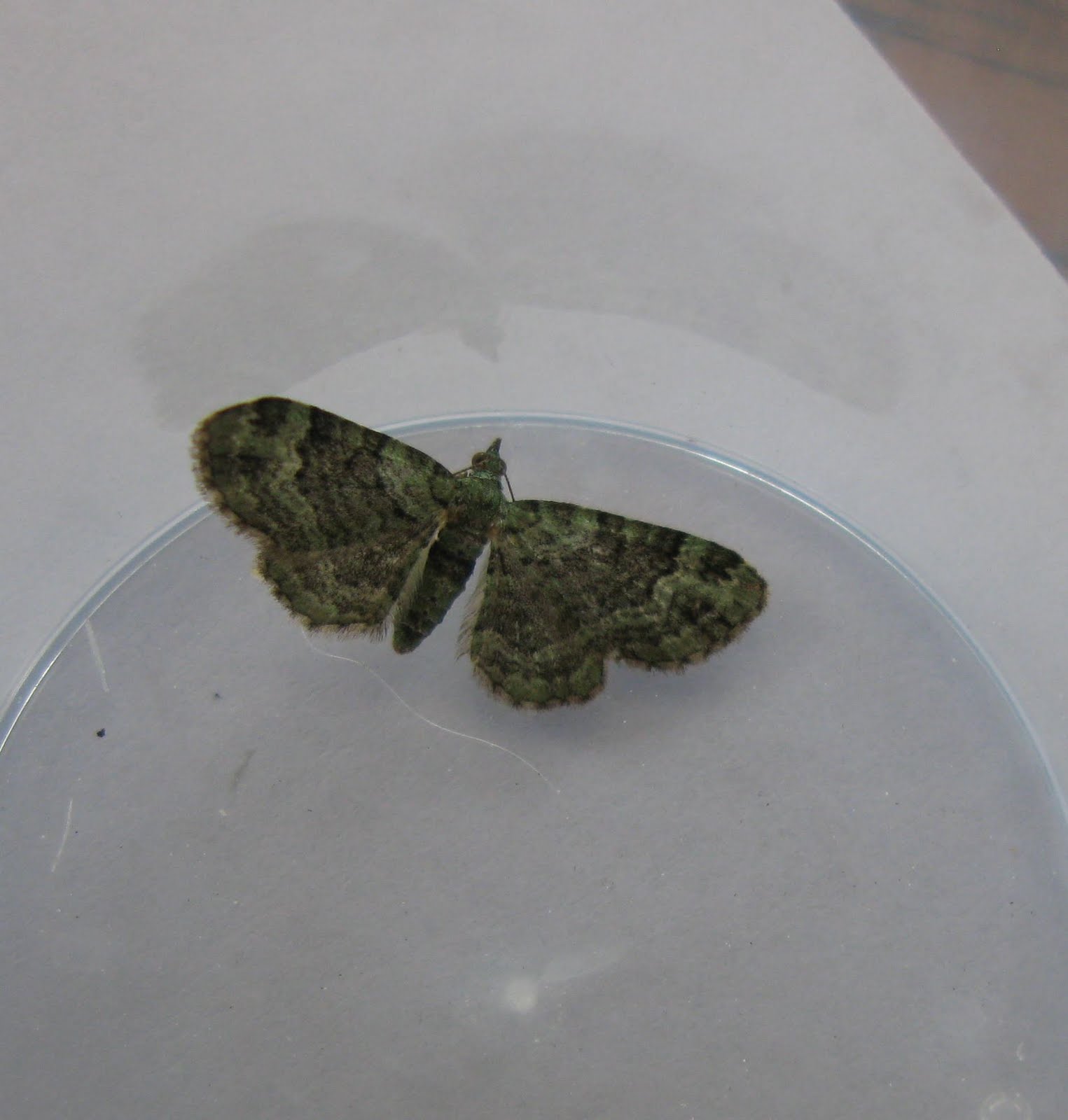
Two more moths, one new for Islay

Like Becky, I was running a moth trap in the garden last night and caught these two interesting moths which, however, are much less spectacular than her Elephant Hawk-moth.
The Shark appears to be the first record for Islay since 1983. There are three other earlier records, two in the 1970s and one in 1941. There were two on Colonsay in 2007. So it is recorded for the islands but not very often.
The Green Pug, on the other hand, is, I think, new for Islay, and with no records for either Colonsay or Jura. However, there have been three records in the last ten years from Mull to the north and one from Rathlin Island to the south off the Northern Ireland coast, which pretty much bracket us!  I have sent the photograph to an expert for confirmation but I'm reasonably confident in my identification of it!
Malcolm
Shark (c.24 mm long)


Green Pug (c.11 mm long)

Thursday, 30 June 2011

Elephant Hawk Moth - Deilephila elpenor

Last week I was very excited about finding a Small Elephant Hawk Moth at Killinallan. Now I'm pretty sure this is an Elephant Hawk Moth (its larger, less colourful relative). It was attracted to the Trust's moth trap which I put out last night. This is not so rare as its smaller cousin, but I was still very excited and pleased to see it fly like the wind when I released it after photographing it. Becky

An easy sedge!

There are about 35 different sedges on Islay, out of over 100 occurring in Britain. Some are quite difficult to tell apart, but others are relatively easy, including this one: Green-ribbed Sedge (Carex binervis). It is quite tall, from 30 to 90 cm (1 to 3 feet), occasionally more, and is particularly distinguished from other sedges by the arrangement of the one male and two to four female spikes. The male spike is, as usual, at the top - long and thin - with a small female spike immediately below it, and then longer gaps to the subsequent female spikes, with the bottom one the largest, and with quite a long stalk so that it generally hangs downwards.

There, said it was easy!
Malcolm

Wednesday, 29 June 2011

Recovery from the storm

I posted a photograph of a completely brown Rowan tree just after the May 23rd storm with all its leaves scorched by the salt. While some trees and bushes show little or no recovery (leading to a few visitors asking us what disease all our trees are suffering from!), others, like this Rowan, photographed again today, are sprouting new green leaves.
Malcolm

28th May 2011


29th June 2011


Family Activity Sessions in July and August

Fiona MacGillivray will be leading our Tuesday afternoon family activity sessions and has an exciting programme drawn up. See poster above for details.

More photos from Mark and Sally Johnson

Dark Green Fritillary

Gruinart gate post

Four-spotted Chaser

Garden Tiger Moth Caterpillar

News from our lepidopteran world

It's all happening here this morning with our first Small Tortoiseshell having emerged from its chrysalis and the Fox Moth caterpillars having hatched. The butterfly has now been released.
Becky

Tuesday, 28 June 2011

A new ladybird for Islay

Thanks to the keen eyes of Gill, who spotted it on Bob Paget's allotment at Port Charlotte, and Bob's interest in wildlife, we have the first record of Orange Ladybird (Halyzia 16-guttata) for Islay. And, as you can see from the photograph, it has white spots not black ones (there is only one other species - the Cream-spot Ladybird - which has white spots, but only 14 not 16 of them!).
Orange Ladybirds feed mainly on mildew, with aphids, the mainstay food for the majority of ladybirds, only eaten occasionally. Their habitat is woodland, which Bob's allotment certainly is not, though there is some woodland only a couple of hundred yards away.
There is a single record for Colonsay in 2008, so this is a second record for the three islands.
Photographing it as it scurried around the glass jamjar Bob had put it in wasn't easy, so I've also included a photograph by Mike Majerus who wrote the definitive work on the group in the Collins New Naturalist series.
Malcolm


Monday, 27 June 2011

Flora and fauna at Ardnave 27th June 2011

We had a record number of 13 people on today's ramble and here is the list:

BIRDS
Meadow Pipit, Grey Heron, Sand Martin, Swallow, Ringed Plover, Redshank, Oystercatcher, Lesser Black-backed Gull, Common Gull, Mute Swan (and two cygnets), Tufted Duck, Lapwing, Whimbrel, Wheatear, Eider, Chough, Jackdaw, Linnet, Rock Dove, Herring Gull, Mallard, House Sparrow, Starling, Arctic Tern

MAMMALS
Rabbit, Grey Seal

LICHEN
Xanthoria parietina, Lecanora gangloides, ramalina sp.

INSECTS
Small Heath

FLORA
Bird’s-foot Trefoil, Meadow Buttercup, Bulbous Buttercup, Dove’s-foot Cranesbill, Water Mint, Brooklime, Forget-me-not sp., Lady’s Bedstraw, Marsh Marigold, Silverweed, Germander Speedwell,
White Clover, Red Clover, Lesser Trefoil, Daisy, Mouse-ear sp., Early Marsh Orchid, Eyebright,
Marsh Thistle, Spear Thistle, Creeping Thistle, Marsh Lousewort, Cuckoo Flower, Lesser Spearwort,
Ragged Robin, Crested Dog's Tail, Common Nettle, Yellow Iris, Common Storksbill, Bracken, Cat’s-ear,
Butterwort, Chalk Milkwort, Marsh Horsetail, Hare’s-tail Cottongrass, Star Sedge, Tormentil, Bog Pimpernel, Meadowsweet, Wild Thyme, Water Cress, Tufted Vetch, Fairy Flax, Self-heal, Yellow Rattle, Dandelion, Yorkshire Fog

Bog Pimpernel - Anagallis tenella
Becky

Photos from Duncan Taylor

The Taylor family really enjoyed their visit to Islay. Here's an extract from Duncan's email:

Click to see the Swifts!

Bat
My parents and I dropped in to the centre a couple of times during our
week on Islay last week and the second time we spoke to someone about
the bats we had spotted flying out of the eves of the bungalow we were
staying in. I promised to send any half decent pictures I had got so a
couple are attached here. We couldn't work out what sort of bats they
were, we saw them emerging from around 10:25 to 11:00 by which time it
was getting too dark and cold to keep watching. I guessed them to be
around 8-10cm long and I can tell they aren't long eared bats but beyond
that I have no real idea.

We also said we had seen swifts at the monument on the Oa on the 16th
June, around 10 to 20 suddenly appeared and wheeled around calling even
flying low enough for me to hear the whiffle of the wind in their
feathers as they swooped past. They flew around for a few minutes before
vanishing as suddenly as they had appeared and if I had realised how
rare that was for Islay I'd have tried harder to get a photo of them. I
was taking a panorama of the view at the monument and looking now I can
make out that I have photographed them, although you may need to take my
word for it that they aren't just dust on the camera.

Photos from Mark and Sally Johnson

Thanks to Mark and Sally Johnson, regular visitors to the island and enthusiastic photographers, for these fantastic photos.

Diving Beetle

Female Adder

Black Guillemot

Mating Common Blue Damselflies

Bottle-nosed dolphins - Port Charlotte

Pictured off Port Charlotte pier a few minutes ago - heading south towards Port Mor.  At one stage they were right out in the middle of the loch towards Bowmore...
Carl

Bottle-nosed Dolphins in Loch Indaal

I have just seen a small pod of Bottle nosed dolphins heading up Loch Indaal at Port Charlotte.  Am going out to investigate...
Carl

Sunday, 26 June 2011

Cross-leaved Heath

Yesterday, Carl posted a photograph of Bell Heather. The other heather species out just now, ahead of the blooming of the Common Heather, or Ling, late in the summer, is Cross-leaved Heath. Superficially similar, the key difference is that the stem leaves of the Cross-leaved species are in distinct and separated whorls of four, while the leaves of Bell Heather are much denser and, if you look closely, in threes. Bell Heather is also usually a much darker purple as Carl's photo shows. The two species can be found growing side by side.
Malcolm

Saturday, 25 June 2011

Cinnabar Moth - Tyria jacobaeae

Probably newly emerged - and looking here like a character from Doctor Who...

Some flowers from our ramble at Sanaigmore yesterday

Bell Heather

Bird's foot trefoil

Water forget-me-not

Sea purslane

Sea sandwort

Friday, 24 June 2011

Nature Ramble at Sanaigmore

Just four of us enjoyed a leisurely ramble down to the beach and then over the burn to the east and onto the area of flat wet ground over the burn.  We were hoping to find a Marsh Fritillary, but no luck today, the Lepidoptera were confined to a number of Small Heath butterflies and a newly emerged Cinnabar moth.

The list of flora was:  Thrift, Forget-me-not, Carnation sedge, Birds-foot trefoil, Yellow flag, Monkey flower, Silverweed, Marsh marigold, Meadow buttercup, Daisy, Hemlock water dropwort, Watercress, Sea Rocket, Sea dock, Sea mouse ear, Ragwort, Butterbur, Sea purslane, Marram grass, Lady's bedstraw, Bell heather, Bog asphodel, Deer grass, White clover, Common sorrell, Shepherd's purse, Small-leaved cranesbill, Dog violet, Common speedwell, Eyebright sp., Ragged robin, Lady's smock, Water mint, Star sedge, Pennywort, Meadowsweet, Water stitchwort, Wild thyme, Foxglove, marsh thistle, Heath spotted orchid, Lousewort, Tormentil, Heath bedstraw, Sea sandwort.

We also found Hard fern, Lady fern and Royal fern, plus at least three lichens that we would need Becky to identify....

Our only mammals were rabbits, and birds were hard work but we did see Sand martin, Wheatear, Meadow pipit, Oystercatcher, Pied wagtail, Skylark, Ringed plover, Common sandpiper, Linnet, Jackdaw, Herring gull, Common gull, Great black backed gull, Lapwing, Dunnock, Rock dove, Shag, Swallow and Raven.

We also found this snail which I would suggest is Trichia striolata - the Strawberry snail

A ventral view - just to be good...  :-)

Final stage of Chrysalis

We are in our final stage of  the whole cycle of a butterfly and waiting for the great day when these chrysalis splits and butterflies begins to emerge .

Common carder bumble bee - (Bombus pascuorum)

I am fairly sure that this is the Common carder bumble bee - Bombus pascuorum, on the head of a Marsh thistle. 
Carl

Wild mint identification required

This lovely, fragrant mint is growing in a big lush bed in the Shjorefield, but I am not at all sure what species it might be - it is not yet in flower as you can see.  Any ideas?
Carl

Orchids - Shorefield


Two spectacular orchid spikes from the Shorefield near Bruichladdich.  The cattle have been taken off for the summer and the vegetation is very lush at the moment.  These two spikes could be hybrids between the Northern marsh and Common spotted orchids as they are unusually large.

Common Foxglove (Digitalis purpurea)


There is a spectacular display of Foxgloves behind the bowling green at Bridgend right now...
Carl

Thursday, 23 June 2011

Port Ellen pre-school children

We enjoyed a visit from pre-school children from Port Ellen this morning...

Another new moth for Islay!

Visitor, Shirley White, took these two photographs of this small (12-15 mm, half an inch) beautiful blue moth near Port Charlotte which turns out to be a Forester (Adscita statices), not previously recorded here, though it does occur on mainland Argyll. The adults fly during the day and drink nectar including, as one of the reference books says, from Ragged Robin, just as this one was. Very well spotted, Shirley!
Malcolm

Wednesday, 22 June 2011