Showing posts with label common seal. Show all posts
Showing posts with label common seal. Show all posts
Tuesday, 10 May 2011


Monday, 28 February 2011
Rhinns Lighthouse and Mackenzie Island
 |
| It was a lovely spring day yesterday so we went down to Portnahaven - this is the Rhinns Lighhouse on Orsay island with Mackenzie island in front of it. |
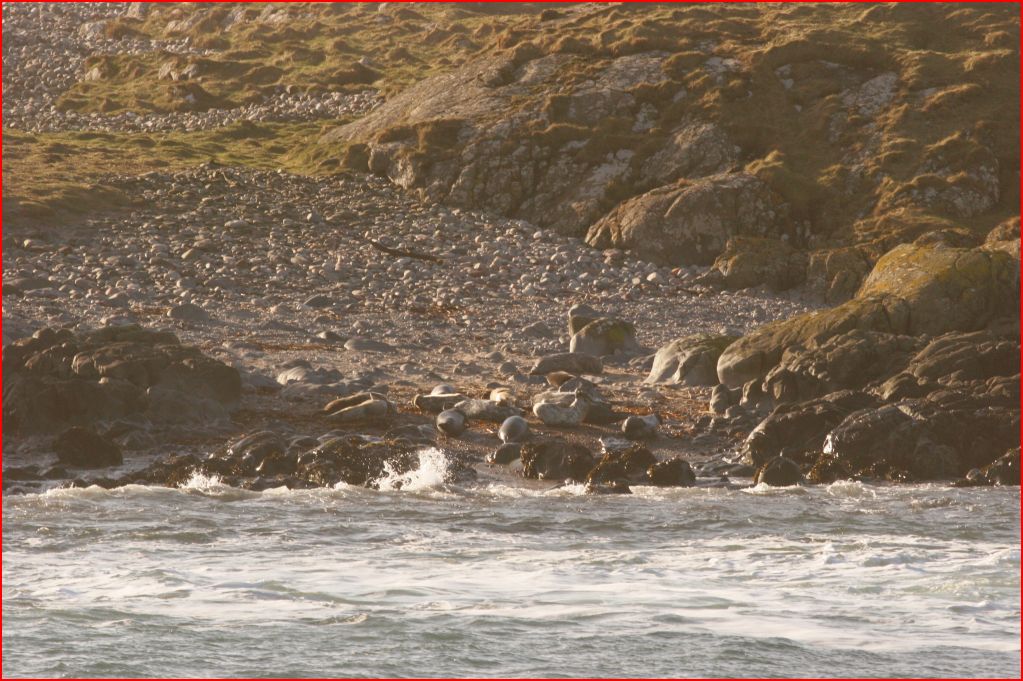 |
| There were a couple of groups of seals hauled out on Mackenzie. Would not like to say whether they were Grey of Common - a bit too far away to determine head shape or nostril alignment... |
 |
| That is Frenchman's Rock in the distance - one of the best sea-watching spots on the west coast. Check out its location on a map and you will see why. In an onshore breeze thousands of birds are funnelled through the passage. Seawatchers have to be brave in a stiff wind however - and have plenty of dry hankies to keep the binoculars from salting up... |
 |
| It was not a particularly windy day yesterday, not by Islay standards anyway. The waves however, were something else... Carl |
Thursday, 6 January 2011
"What do seals eat? Seals poop, Scientists scoop!" - Lindsay Wilson writes....

The harbour seal is in decline around Scotland. Trying to understand why is a group of scientists from the University of St. Andrews Sea Mammal Research Unit.
What and how much do seals eat? This is what PhD student Lindsay Wilson is trying to work out. Travelling the coast of Scotland every 3 months, including visits to Islay, Jura and Gigha, Lindsay and her small team spend most days on the water looking for seals.
 |
| Lindsay and Ross Waddams plan their scooping strategy in Orkney where they used a helicopter to access the colonies |
Over the last 10 years harbour seals have declined by one-third around Scotland (current estimate 20,000 animals) while the grey seal population has expanded dramatically (current estimate 180,000 animals). Lindsay has visited the islands twice in the last 6 months as part of a yearlong study to understand what role diet may play in the expansion or decline of Scotland’s seal populations.
Working mostly from a boat the team scans the coastline looking for seals. Once located seals are counted and identified to species before the team make their way ashore to collect seal scat (faeces). Samples are scooped into plastic bags, much like you would pick up after your dog and sent back to the lab to be analysed. Using the hard parts of prey which remain in the scat, the team can identify between different fish prey such as sandeel and cod using ear bones (otoliths) and between squid and octopus using their beaks.
 |
| Scooping action near Port Ellen |
Through scat analysis Lindsay hopes to document the diet of Scotland’s harbour seals and answer a number of questions. Recent population estimates for the west coast showed no decline in seal number whereas seal counts in Orkney suggest the harbour seal population has declined by up to 65%, are the seals in these different areas eating different prey? By collecting scat over a 12 month period the team hope to understand, does diet change throughout the year? And, by understanding the diet similarities or differences between harbour and grey seals, is there competition between grey seals and harbour seals for prey?
Lindsay and her team continue to travel around Scotland collecting seal scat and will be back visiting Islay and Jura again soon to try and understand what and how much seals eat. You can follow their exploits on their web diary at
http://www.sealdietscotland.co.uk/
 |
| http://www.photo-natur.de/ |
Wednesday, 17 November 2010
Young Grey Seal (Halichoerus grypus). Nostrils are the key to ID

Thanks to Bob Davison for this picture of a young grey seal (above). One of the best ways to tell a young Grey seal from a Common seal (Phoca vitulina) is to look at its nostrils. The Greys have nostrils that are kind of parallel, whereas those of the common are much more V-shaped and almost meet at the bottom (below).
However, that's all very well if you have an obliging seal that does not mind having its nasal appendages examined in some detail. This is not always that easy to do. As usual with these little identification issues, it is always easy to tell a common seal from a grey seal when you are in the pub, but it is not always quite so easy when you are in the field... Full adults are less of a problem - the greys are much bigger for a start.... Well, usually....

Seals can of course 'seal' their nostrils while underwater. They can also sleep while holding themselves vertically in the water with their heads above the surface - but only for around 90 seconds at a time...
Sunday, 31 October 2010
Wildlife Photography Competition - Chris Bell

Thanks to Chris for sending us this classic Islay wildlife shot of a seal lying on the rocks down in the harbour at Portnahaven.
Subscribe to:
Posts (Atom)