Showing posts with label caterpillar. Show all posts

Friday, 10 August 2012

Guess who?

I found this little fella amongst some dead heather on Colonsay on Wednesday. The heather was quite young, yet great blocks of it were brown, particularly the north facing slopes, could this be an effect of the large numbers of heather beetle in the Spring? Is there something else going on?

And who is he? An albino Emperor moth caterpillar? A very poorly one? I'd be mighty interested if anyone knows...

Crystal

Thursday, 5 July 2012

Peacock Caterpillar weaves its chrysalis


MVI_0256 a video by Sgeir Mhor on Flickr.

A snippet of yesterday's caterpillar in action, including the decapitation of itself!

Lorna

Wednesday, 4 July 2012

Butterfly Update

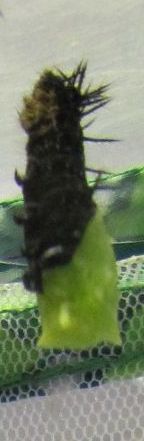
Shortly after arriving for another day at the visitor centre this morning, I began doing the rounds, checking all the creatures were alright. I was so excited when I noticed this Peacock Butterfly caterpillar beginning its transformation into a chrysalis, having missed the other 5 or so. For the next 8 minutes (9.38 am -9.46 am) I keenly watched  the fat caterpillar get shorter and shorter, squashing itself into its shiny green tent. I have captured the action in this sequence of photos as best I could amongst a maze of fellow chrysalises! The final stage was for the hard worked caterpillar to decapitate itself (almost). You will see this in a video to follow.
9.38am

9.38am

9.41am

9.44am: It looked like a real struggle!

9.46am: Once the major transformation was complete, there was much writhing, squirming and twitching. The chrysalis gradually darkened to brown.


The 'Big Question' in July's BBC Wildlife Magazine is all about how a caterpillar turns into a butterfly. In my reading, I have discovered that a caterpillar's juvenile hormone 'slows progress towards adulthood', keeping it a larva while the hormone's levels are high. Gradually the juvenile hormone slows down and falls below a critical level, triggering the final moult into a chrysalis. Inside the chrysalis, the caterpillar is basically recycled, and adult features finally develop!

Lorna

Friday, 22 June 2012

RSPB Moth Extravaganza

Lorna and I thoroughly enjoyed the moth night hosted by the RSPB last night. Thanks to all involved, particularly Josie and Beki. We were shown and told about various methods of trapping, including light trapping, wine-soaked rope trapping (!) and pheronome trapping. Surprisingly the moths were not attracted to the red wine, but we did catch lots of Map-winged Swifts in the light trap. We also heard (via the bat detector) and saw Pipistrelle bats flying round the Visitor Centre at Gruinart. Thanks also to Margaret for the delicious Gingerbread!
Becky

The moth trap

A tiny caterpillar - as yet unidentified

Wednesday, 24 August 2011

Narrow-bordered Bee Hawk Moth

A representative of Butterfly Conservation Scotland was over last week surveying Marsh Fritillary caterpillars. He really liked our butterfly display! He's going to send more records, but for now sent in this great photo of a Narrow-bordered Bee Hawk Moth larva. Thanks Paul!
Becky

Narrow-bordered Bee Hawk Moth caterpillar

Tuesday, 12 July 2011

Ramble in Bridgend Woods

Lorna and her boyfriend went for a ramble in Bridgend Woods and added to their holiday bird etc list. Here's a few of Mark's photos:

Speckled Wood
Common Lizard
Emperor Moth caterpillar

Thursday, 19 May 2011

Butterfly Pavilion Update


I was very excited this morning when I went to check the caterpillars we'd put in the pavilion last night because not only were they crawling all over the place and looking lovely and healthy, but, wait for it, there were some eggs that I'd not noticed before. The top picture shows what I think are Peacock butterfly eggs because they look a bit like miniscule gooseberries.

The bottom picture shows both Small Tortoiseshell caterpillars (stripey) and Peacock caterpillars (black) in our pavilion.

Becky

Wednesday, 18 May 2011

Peacock Butterfly Caterpillars

The rock pooling was impossible today due to high tide, but we followed Malcolm's advice and searched through the nettles at Port Mor, looking for Peacock Butterfly eggs which I told everyone looked a bit like tiny gooseberries. Darcy was the first person to find them, but they weren't eggs anymore, they had just hatched into tiny black caterpillars, lots of them. It was a very exciting moment.

But there was more to come when Darcy (again) called over that she'd found more caterpillars that looked a bit different. This time they were Small Tortoiseshell caterpillars which also feed on nettles. I was ecstatic! The ones shown above are the Peacock caterpillars; the Small Tortoiseshell ones didn't come out but I'll try again tomorrow.

We have taken a few of each species to put in our butterfly pavilion at the centre. Do come and have a look when we open next week.

Becky

Monday, 16 May 2011

Geometrid Moth Caterpillar


We saw this tiny caterpillar on the Oa and watched it 'loop' its way across my rucsack. I was fascinated to read the explanation for this behaviour in wikipedia:

The name "Geometridae" ultimately derives from Latin geometra from Greek γεωμέτρης ("geometer, earth-measurer"). This refers to the means of locomotion of the larvae or caterpillars, which lack the prolegs of other Lepidopteran caterpillars in the middle portion of the body, with only two or three pairs at each end. Equipped with appendages at both ends of the body, a caterpillar will clasp with its front legs and draw up the hind end, then clasp with the hind end (prolegs) and reach out for a new front attachment - creating the impression that it is measuring its journey. The caterpillars are accordingly called loopers, spanworms, or inchworms after their characteristic looping gait.

Becky

Sunday, 10 April 2011

Drinker moth

I found this fine hairy fellow in the garden this afternoon. I had to bring it indoors to photograph it as all it wanted to do was curl up and hide itself among the grass. The caterpillars of this moth appear in August and feed on various grasses until the weather turns cold, when they burrow down to hibernate in the bases of grass tussocks. They re-emerge about now and carry on feeding until June, when they pupate and hatch into quite a large pale brown moth (5-6 cm wingspan).
Malcolm

Tuesday, 1 March 2011

Oak Eggar Moth caterpillar

 Found my first caterpillar of the year yesterday while walking the shore between Port Charlotte and Bruichladdich.  I would suggest it is an Oak Eggar moth (Lasiocampa quercus), although my caterpillar identification is not the best...
Carl
Full description - UK Moths