|
| Pictured on Sunday |
Showing posts with label Saligo. Show all posts
Showing posts with label Saligo. Show all posts
Monday, 11 March 2013


Thursday, 14 February 2013
Blonde Ray Egg Case
Back in June we posted a photo of a Blonde Ray eggcase which Mary McGregor had found. It is one of the largest 'mermaids' purses' (or eggcases of Rays, sharks and skates) to be found on British shores. On my recent walk at Saligo whilst I was collecting driftwood, Lynda and Brier were finding yet more mermaids' purses. They found two Blonde Ray cases. I think they were a little smaller than the one Mary found, but sizable nevertheless.
Becky
Becky
 |
| Blonde Ray Eggcase |
Sunday, 10 February 2013
Where have you gone sunshine?
In case (like me) you've forgotten what our beautiful island is like in the sunshine, here's a few photos from last weekend when, contrary to this one, the sun came out for the first time in ages. I went a walk at Saligo to Loch Corr and Cnoc an Tighe, one of many poignant ruins on our island.
Becky
Becky
 |
| Loch Corr |
 |
| Detail of Saligo rocks |
 |
| Cnoc an Tighe |
Thursday, 10 January 2013

Tuesday, 1 January 2013
Loch Gorm - Kirsty Wither

Thanks to Kirsty for this phone shot out across Loch Gorm towards Saligo taken yesterday in the late afternoon.
Saturday, 27 October 2012


Wednesday, 24 October 2012
Saligo on a Smartphone


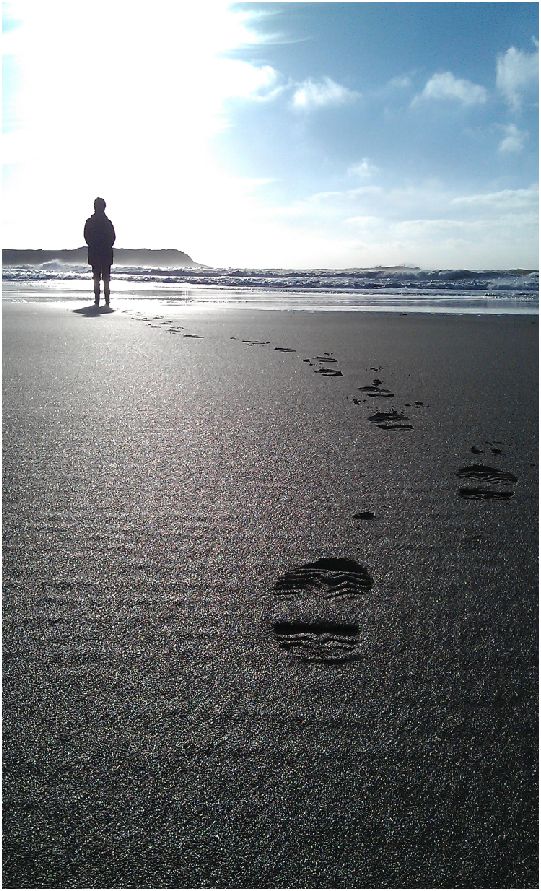
Three shots of Saligo taken on Sunday afternoon on an Android Smartphone. No processing.
Wednesday, 11 July 2012
Cockchafer Beetle
On Tuesday, someone presented me with an unidentified beetle that appeared to be washed up at Saligo Bay. I'm sorry, I didn't get any pictures (it was very smelly and upon identificaction, was dealt with quickly!), but if that someone sees this entry, then thanks for bringing it in. As I thought at the time, it was a cockchafer beetle.
Lorna
Lorna
Sunday, 3 June 2012
Machir Bay to Saligo (Part 2) (Diamond Jubilee)
This weekend has been one long wildlife fiesta for Lorna and me. To honour the Queen's Diamond Jubilee here is 60 species of fauna and flora we've seen this weekend:
Blackbird, Pied Wagtail, Meadow Pipit, Rock Pipit, Arctic Tern, Shag, Fulmar, Lesser Black-backed Gull, Common Gull, Gannet, Black Guillemot, Shelduck, Eider, Redshank, Oystercatcher, Grey Heron, Kestrel, Buzzard, Ringed Plover, Jackdaw, Chough, Wheatear, Starling, Corncrake, Rock Dove, Lapwing, Greylag Goose, Sand Martin, Swallow, House Martin, Wood Warbler, Willow Warbler, Whitethroat, Dunnock, Robin, Great Tit, Song Thrush, Wren, Redpoll, Linnet, Goldfinch, Treecreeper, Chaffinch, Mute Swan, Four-spotted Chaser, Golden-ringed Dragonfly, Large Red Damselfly, Green Hairstreak, Marsh Fritillary, Small Heath, Red Admiral, Green-veined White, Small White, Hare, Rabbit, Common Frog, Roach, Round-leaved Sundew, Heath-spotted Orchid, Lousewort
Part 3 coming soon!
Becky
 |
| Marsh Fritillary |
 |
| Round-leaved Sundew |
 |
| Redshank |
 |
| Ringed Plover |
Saturday, 2 June 2012
Machir Bay to Saligo (Part 1)
What a wonderful walk David Formby, Lorna and I had today round Coul Point, from Machir Bay to Saligo. It's been difficult selecting photos from the many Lorna took, but here is part one:
Becky
 |
| Eider Family, north of Machir Bay |
 |
| Frog, near Saligo |
 |
| Green Hairstreak (Callophrys rubi - 'beautiful eyebrow') |
 |
| Kestrel |
 |
| Thrift on cliff |
Sunday, 13 May 2012

'Opera Rocks' and coastline at Smaull


The well-kent landmark rocks north of Saligo have been steadily changing their name from 'Braigo Rocks', which I have never heard anyone use, to 'Opera Rocks' because of their resemblance to the famous building in Sydney Harbour, which was of course only finally completed in 1973. I am sure they have a Gaelic name too, though I do not recall seeing one. It is a spectacular section of Islay's coastline. Carl

Tuesday, 1 May 2012


Common Scurvy Grass - Saligo
 |
| Common Scurvy Grass (Cochlearia officinalis) is abundant on the wet Machair south of Saligo at the moment. It is a member of the cabbage family. Captain Cook carried it on his ship, correctly believing that eating it would provide protection from scurvy. Sadly, nobody else in authority believed him and thousands continued to die from vitamin C deficiencies caused by poor diet on long voyages. |
Subscribe to:
Posts (Atom)