Tuesday, 20 December 2011

A keen snowdrop

A snowdrop almost out, photographed in Gruinart Wood yesterday by Mary McGregor, to whom thanks.
Malcolm

Sunday, 18 December 2011

Dawn

Port Charlotte this morning

Saturday, 17 December 2011

Fallow Deer with cattle - Niall Colthart


Nice shot this - a young fallow deer scrounging a meal from a cattle trough.  Taken by Niall Colthart during a walk to Proaig and MacArthur's Head.

Ireland from above Octomore Farm

I was up above Octomore this afternoon.  There were some  fierce hail showers about.  The village in the left foreground is Port Charlotte.  Ireland is just visible on the horizon to the right.  Carl

Jura from Bowmore

Taken yesterday - Carl

Friday, 16 December 2011

Glorious Evening

Bowmore from Carnain this evening.  A hard frost is developing - Carl

Barnacle geese on seaweed

Barnacle geese feeding on seaweed near Gartmain this morning.  They seem to be particularly attracted to seaweed at the moment. maybe it is because there is more than usual because of the storms?  Ot maybe the grazing is deficient in some way because of the very difficult weather both now and in the autumn? - Carl

Shorefield bullocks this morning

My favourite cattle and my favourite view!! - Carl

Black Rock this morning

It's been so long since my last post that I forgot the email address to sign in this afternoon! Hurray! After weeks without a camera, I now have an early Christmas present of a new extra super duper lens!  Today was an ideal day to try it out - so still, so tranquil, so cold, yippee! I love it! Only problem now is that I'm using my son's mac computer to post this because my camera's fixed, but my computer's now dying!

Becky

Black Rock

Looking across Loch Indaal from Bruichladdich

Ice on the puddles


There was ice on the puddles this morning in Port Charlotte for the first time this year.
Carl

Thursday, 15 December 2011

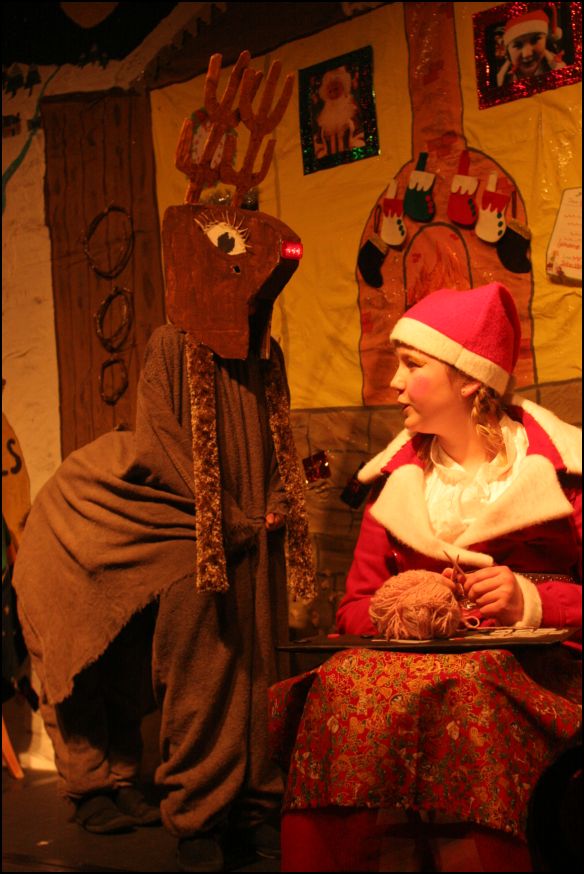
Reindeer spotted in Keills!! Will he be at the talk tonight?


This reindeer was spotted at Keills Primary School last night.  Not sure whether he will be turning up at Mary's talk tonight (he is very busy at this time of year) - but you never know your luck!!  Hope to see you there...  Much mince-pie-making has been occurring...
Carl

Phew - a pleasant morning...


It is a relief to be able to report on a pleasant, benign morning on Islay after all that meteorological lunacy.  We even have some sunshine...  This was Loch Indaal from Lorgba this morning.
Carl

Tuesday, 13 December 2011

Monday, 12 December 2011

Scottish Water Press Release


FATS: The way to do it
With the ‘season of goodwill to all’ around the corner, Scottish Water is asking customers in Argyll & Bute to extend that feeling to our feathered friends.

Across the country Scottish Water is encouraging customers to dispose of cooking fats, oils and grease responsibly.
Over time cooking fats and oils poured down the sink or drain can cause sewer chokes, sewage discharges, pumping station failures and damage to the environment. 

It is important that families dispose of cooking fats responsibly by putting it in a sealable plastic container first and then bagging and binning them with their household refuse. Animal fats and meat juices can actually harm our feathered friends and therefore such kitchen scraps should not be used to feed winter birds. 

RSPB Scotland’s Louise Smith said: 

“Using fat from roasting tins to feed to garden birds is a big no-no. The juices mixed in roasting tins will go off very quickly and could cause disease on bird tables. Birds are very susceptible to this during the colder months. Fat from meat juices could also damage birds’ feathers at a time when they need to be in tip top condition to stay warm.  But don’t let this put you off feeding garden birds – there are loads of leftovers that are perfectly suitable.”
Scottish Water supports the RSPB’s campaign to encourage householders to leave out leftovers such as cake and biscuit crumbs, mild grated cheese, cooked rice, porridge oats, cooked potatoes and bruised fruit. However we are asking our customers not to leave out fats from roasting tins, frying pans or pots.

Such animal fats can smear onto birds’ feathers, reducing the insulation and water-proofing. High levels of salt can also be dangerous for our feathered-friends and the incorporated meat juices can quickly turn rancid providing a breeding ground for salmonella and other such food related bacteria.

Mrs Jane Mckenzie, Scottish Water’s Regional Community Manager for the area, added:

“While it is important that our customers do not pour fats, oils and grease down the kitchen sink or drain, it is also vital that they dispose of such residue responsibly, rather than leaving it out for winter birds.

“There is a misconception that sewers are vast, cavernous tunnels but in truth the majority are very narrow pipes, of no more than a few inches in diameter. It is very easy for these narrow pipelines to become blocked, causing waste water to back up and spill, spoiling the natural environment.”

Scottish Water has found that 55 per cent of all sewer blockages are caused by people disposing of cooking fat down their sink. It is an offence under the Sewerage (Scotland) Act 1968 to dispose of fat, grease or oil down a sink.
Fats, oil and grease in liquid form may not appear to be harmful but as it cools it congeals and hardens. This can then cause blockages to the inner lining of drainage pipes, which can lead to waste water flooding into gardens and properties, causing a health hazard to wildlife and the local environment.   In extreme cases, blocked sewers can spill into burns, rivers, streams and beaches, causing environmental damage.
FATTY FACTS

Fat blockages cause pollution, flooding, public health hazards and have major clean up costs.
Saturated fat causes the most problems. This is animal fat which goes hard when it cools.
Mono-unsaturated fats such as olive oil and rapeseed solidify when refrigerated so can cause problems in sewers in cold weather

Scottish Water advises customers to allow fats, oils and grease to cool before disposing of it responsibly in a fat trap or by popping it into a sealable plastic container and then into the bin, to be disposed of along with the remainder of their household rubbish.

For more information on our ‘Fat Trap’ and ‘Bag It and Bin It’ campaigns visit 
www.scottishwater.co.uk/fattrap. 

Sunday, 11 December 2011

More geese roosting

With the weather continuing on the poor side of not very nice, I've been raiding my archives for photographs I took earlier. This second recent one of mine of Barnacle Geese roosting during the day on the mud at the head of Loch Indaal presents a nice little headache for unwary goose counters. Because of the reflections of the geese in the very shallow water on this calm day, one really does have to concentrate to only count the geese that are the right way up!
This photograph could also answer a question I've occasionally been asked. We know that geese stand on one leg because it is more comfortable, but from this photo how many are right-footed and how many are left-footed? I don't know because I've not checked. Anyone out there like to try........? And of course, it begs a second question which the photo can't help with. How often do they swap legs - if they do?
Malcolm

Friday, 9 December 2011

A calm winter's evening


The speed with which the weather changes on Islay is of course a very ancient cliché, but it still never fails to amaze this commuter between Port Charlotte and Bowmore.  This was the tranquil scene over Loch Indaal to the Paps from near Kilarrow House this evening...
Carl

Thursday, 8 December 2011

A blustery day...

Bowmore Distillery at around 14.45 this afternoon

Orsay Island at around 11.30 this morning
A couple of snaps from the island this morning.  Force ten today and all the schools were closed, but not a big deal by Islay standards.  I believe conditions were actually worse on the mainland.
Carl

By the wind sailors

This evocative name is given to these oceanic floating hydrozoans (aka Velella velella) which get washed up on our beaches after westerly gales (of which we've had several recently). The RSPB's David Wood photographed these on Machir Bay last Saturday where he said there were hundreds on the beach. They still have some of their blue "flesh" which quite rapidly decomposes leaving the whitish inside "skeleton". From Wikipedia: "Each Velella is a hydroid colony, and most are less than about 7 cm long. They are usually deep blue in colour, but their most obvious feature is a small stiff sail that catches the wind and propels them over the surface of the sea". The sail is clearly shown in the photograph.
Thank you, David.
Malcolm

Wednesday, 7 December 2011

Roe deer in autumn colours

A Roe Deer matching the autumn colours of Juncus in the foreground and bracken behind. I took this photo yesterday during a lull in the prolonged gales we are currently experiencing.
Malcolm

Tuesday, 6 December 2011

Grey and White


We really have had a very difficult period of weather recently.  Today the wind abated for a while, but it rained very heavily shortly after this photograph was taken, probably melting the snow off the hills, much of which was probably ice from hailstorms anyway.  I cannot personally recall having had so many hailstorms as we have seen in the past couple of weeks.
The relatively benign, if wet, conditions we have right now are about to disappear with winds gusting to 55 mph forecast for Wednesday and 74mph for Thursday.
Carl

Sunday, 4 December 2011

Next talk at the Centre - "Scotland's Reindeer" - Mary McGregor - Thurs 15th December

Mary says - "Reindeer were re-introduced to the Scottish Highlands in 1952 by a Swedish Sámi by the name of Michal Utsi. I began working with them in the winter of 2000 and was immediately addicted to their amazing natures. I returned to work there for the best part of ten years, as both seasonal staff during my studies, and later as a full time reindeer herder.
"The reindeer roam the slopes of some of Scotland's highest slopes feeding on the only sub-arctic territory in the UK, and as a herder it was my job to 'roam' out and locate them throughout the year.
"As an Arctic animal, they are found in the worlds harshest environments. But their range enabled the people of the Arctic to survive there too as they took on the role of cow, horse, sheep and goat: reindeer pull sleighs of people, packages and houses; they provide meat and even milk; in some parts of the world they are even ridden. What better animal to make it around the world and back in one night?

Photo- www.guardian.co.uk
"Through this talk I hope to tell you what makes reindeer so special and how they survive in the Arctic circle, the famous Cairngorm herd and, of course, Christmas!"

http://www.cairngormreindeer.co.uk/History/history_1.htm

Saturday, 3 December 2011

Interesting article on power lines

http://www.birdguides.com/

Thanks for this Malcolm...

Sleeping geese

The Barnacle Geese will feed under the moon when they can and spend the day snoozing on the mudflats at the head of Loch Indaal.
Malcolm

Wednesday, 30 November 2011

Bird Flight Diverter

Following the unfortunate deaths of a number of Whooper swans and other birds this autumn passage due to collision with overhead power cables, particularly where these cables cross arable fields sown with barley, Rop from SSE has brought me examples of three different 'Bird Flight Diverter' systems that he has had experience of on Islay. 
Rop believes that the most effective device is that shown on the left of the picture.  It can be attached to the cables without 'powering down', using a pole handled from the ground.  The clamp is powerful and very good at not moving down the wire once in place.  The connector between the white flight diverter and the black clamp assembly uses a swivel bearing which spins in wind speeds upwards of 3 or 4 knots.  This is not only an additional deterrent, it also lasts longer.  The other, simpler systems break relatively quickly. 
The yellow and buff patches on the white rectangle are made from a special luminous material that absorbs light, which improves the systems effectiveness at night for up to ten hours.
Rop is proposing to do a test installation between Sunderland and Rockside with these flight diverters in the next  couple of weeks and has invited me along to see what happens and take photographs.  The plan is to do an assessment of the numbers required and the locations where they need to be deployed.  We will of course keep you updated...
Carl

Monday, 28 November 2011

The Rinns Lighthouse

Photographed this lunchtime with some amazing sunlight well to the south shining beneath lowering clouds. And for those who like some natural history in the photographs on this blog, I've included a single Herring Gull!
Malcolm

Sea Foam - James Deane


Three lovely shots from James of his daughter Amelie playing in sea foam at Saligo over the weekend. 

Wikipedia tells us - "Sea foam, ocean foam, beach foam, or spume is a type of foam created by the agitation of seawater, particularly when it contains higher concentrations of dissolved organic matter (including proteins, lignins, and lipids) derived from sources such as the offshore breakdown of algal blooms. These compounds can act as surfactants or foaming agents. As the seawater is churned by breaking waves in the surf zone adjacent to the shore, the presence of these surfactants under these turbulent conditions traps air, forming persistent bubbles which stick to each other through surface tension. Due to its low density and persistence, foam can be blown by strong on-shore winds from the beachface inland...."

INHT blog passes 100,000 page views

Pages on the INHT blog have now been viewed more than 100,000 times, which seems a very large number to us and one that we can be rather pround of!  A big thank you to more than 28,000 unique visitors to the site from 137 different countries...  Interestingly, it would appear that fewer than 60% of our visitors reside in the UK, so we really are reaching out across the world.

A particular thank you to all our contributors who have provided such eclectic reading and viewing since we started out in May 2010...

Cheers
Carl Reavey

Sunday, 27 November 2011

Stormy weather

There's a lot of weather about at the moment. In the last few days, we've had gales with gusts up to 60 mph, lightning and thunder, hail, heavy rain squalls, drizzle, mist, low cloud, and occasional bursts of sun, and so all the usual components of late autumn/early winter on Islay.
The sun broke through just now (Sunday pm) and produced this rainbow while close by yet another squall was passing over Bowmore.
Malcolm

Saturday, 26 November 2011

Wet days are great for lichens!

Something to cheer us all up today; Martin sent me two lichen photos from Lochgilphead which reminded me that this wet stuff is appreciated by some living organisms, if not all. The first species is abundant on Islay, but I'm not sure of the second. Both species grow on trees annd the first one is also known as Lungwort (hence its scientific name). I wasn't sure sure of the identification of the second one so sent it to one of the lichenologists who were here in May. I paste his reply to my query here:

"both are Lobaria.
As you say, the first one is Lobaria pulmonaria.
The second is Lobaria scrobiculata. Usually it is more of a brown-grey colour, but when very damp it goes slate-blue, as in the photograph. The network of sharp ridges over the surface is, however, pretty much diagnostic (of this and L. pulmonaria).
In Lobaria pulmonaria, the algal partner is a green alga (Chlorophyta), and so the lichen remains green when wet.


In L. scrobiculata, the "algal" partner is a blue-green alga (Cyanobacteria), and the blue pigment shows through when the lichen is wet."

Thanks for sending the photos Martin!
Becky


Lobaria pulmonaria


Lobaria scrobiculata

Wednesday, 23 November 2011

Barnacle Geese - Loch Indaal

The village of Bruichladdich is in the background

A brace of Grey-lags

The Grey-lag goose population on Islay has risen very considerably in recent years and they are increasingly being targeted by farmers trying to protect their crops.  We are now well into the shooting season for the species.  I understand that most Greylags are shot on Islay using rifles, which have a much greater range than shotguns.
These two are about to have their large breasts removed.  They will be marinaded and flash fried after being sliced very thinly.  Grey-lag breasts have much more fat on them than those from Barnacle geese.
Carl

Common Scoter displaying - George Jackson


Two unusual shots of Common Scoter displaying close to the shore in Loch Indaal by George Jackson.  many thanks George....

Easyfundraising for the INHT at Christmas


http://www.easyfundraising.org.uk/how-it-works/

Hello everyone...

We hope that you will follow the link above and help raise funds for the Islay Natural History Trust while you are shopping on-line, at absolutely no cost to you.  When you click through Easyfundraising to a retailer's website and purchase something on-line then the retailer makes a small donation to  the Trust.  It really couldn't be easier. 
A large number of well-known retailers are part of the scheme, M&S, eBay, Vodafone, John Lewis, Boden, Groupon, Tesco, the National Lottery, GAP, Bank of Scotland  etc. etc etc.

Imagine how much more fun buying all those Christmas presents would be knowing that you are raising money for your favourite Natural History Trust...

Hope you can help...
Best regards
Carl Reavey

The incomparable Saligo Bay


Taken yesterday evening.  Yesterday was a lovely clear day.  Today is rather different...  :-(
Carl

Tuesday, 22 November 2011

Loch Indaal Lighthouse and the Paps

It has been a while since I posted a gratuitous photo of my favourite view, so, as it was a nice day, I climbed off the bike for long enough to grab this snap - Carl  :-)