Showing posts with label Hebridean Whale and Dolphin Trust. Show all posts
Sunday, 10 August 2014
Friday, 12 July 2013
The Hebridean Whale and Dolphin Trust
An email from this worthy Trust reports:
"As you may have heard, the Hebridean Whale and Dolphin
Trust’s project ‘Silurian: the Floating Classroom’ has been shortlisted
in the education category of the National ottery good Causes Awards, for projects
that have received lottery funding in the past. In order for us to win, we need
to gain as many votes as possible via the free online system (for those with an
email address). Voting closes on
the 24th July and the top 3 in each category will be invited to the
awards ceremony where the winner in each category will receive £2000 towards
their project, but more importantly to us is the opportunity to raise the
profile of our little organisation on a national platform."
Please consider voting for them at http://www.lotterygoodcauses.org.uk/project/hebridean-whale-and-dolphin-trust
and watch their promotional video at: http://www.youtube.com/watch?v=JclEsYIE0fI
Thursday, 23 February 2012
Friday, 14 October 2011
Rare Pygmy Sperm Whale strands on Seil Island
A pygmy sperm whale, a very rarely sighted cetacean in UK waters, has stranded near Ellenabeich on the Isle of Seil, south of Oban, prompting scientists from the Scottish Agricultural College (SAC) to investigate. Pygmy sperm whales are rarely sighted and identified alive at sea, and therefore studying the carcass allows scientists to find out more about this elusive species. Since the Natural History Museum started keeping records of stranded cetaceans in 1913, only ten pygmy sperm whales are known to have stranded in the UK previously; three of which were in Scotland, the first reported in 1999. The stranding was spotted on 6th October by Brien and Liz Dickey, who informed John Gordon, a deep-sea fish biologist who is an Honorary Research Fellow at the Scottish Association of Marine Sciences (SAMS) in Oban. He in turn contacted Nienke van Geel, a PhD student at SAMS studying cetaceans on the west coast, who next day made the positive identification and contacted SAC. “We were all astonished, that what at first was reported as a porpoise or dolphin, turned out to be such a rare specimen”. With help from staff from the local Seafari boat operator the whale was removed from the beach ready for collection by SAC. Easdale ferryman, Alan MacFadyen, added, “For my part it was a sad sight to see and thankfully rare. It looked beat up, with surface wounds but no major wounds. It attracted quite a crowd. Seems to have been a few whales spotted about the west coast lately.”
A necropsy, an animal autopsy, was conducted by Andrew Brownlow at SAC’s base in Inverness and preliminary results suggest that the whale, a sub-adult male, was in healthy condition; the blubber layer seemed to be of good thickness; there were hardly any parasites found in the stomach and lung, in fact the whale had been eating shortly before being beached as there was still an undigested squid in the stomach. Results from the necropsy indicated that the animal would have stranded alive. Nienke, who attended the necropsy, said, “It is unknown what caused the animal to strand. Although we are still waiting on histology results, all signs point to a healthy individual.”
Pygmy sperm whales share some common traits with their cousin, the sperm whales; they too have a spermaceti organ in their heads, allowing for echolocation and aiding deep dives to hunt. The main difference is the size; while sperm whales can reach lengths of 18 metres, pygmy sperm whales will reach a maximum of 3.5 metres. Olivia Harries, Biodiversity Officer at HWDT (The Hebridean Whale and Dolphin Trust), commented, “To put the size of the pygmy sperm whale in context; the individual that stranded on Seil weighed about 150kg, the heart of the fin whale that stranded in South Uist weighed about 130kg.”Pygmy sperm whales favour continental shelf and slope regions and deep water so it’s rare to find this species in inshore waters. Their range stretches as far south as New Zealand, whilst Scottish waters represent the most northerly limit of its distribution.
SAC coordinates the Scottish Marine Animal Stranding Scheme with support from DEFRA and Marine Scotland. If you find a stranded animal that has perished please contact SAC on 01463 243030. Moreover, if you find a stranded animal that’s still alive, please contact the British Divers Marine Life Rescue (BDMRL) on 01825 765546. BDMLR are fully equipped to attempt re-float stranded animals, please note that you should never approach a stranded animal without proper training. Sandra Koetter, HWDT’s Sightings Officer, adds, “While it’s sad to find marine mammals on the shore, either alive or dead, by reporting the find you can help to discover more about the species and also what might have caused its death.” This report follows a spate of recent unusual strandings and sightings; a sighting of a live sperm whale in the Sound of Raasay, the fin whale that washed ashore on South Uist and more recently a live sperm whale in Kirkwall Bay (Orkney) and a dwarf sperm whale off Penzance, which might be the first live record of this species in UK waters. If you spot a cetacean, in its natural environment at sea, please report it to HWDT online at
http://www.hwdt.org/
Monday, 10 October 2011
Tuna washes ashore on Mull - Hebridean Whale and Dolphin Trust
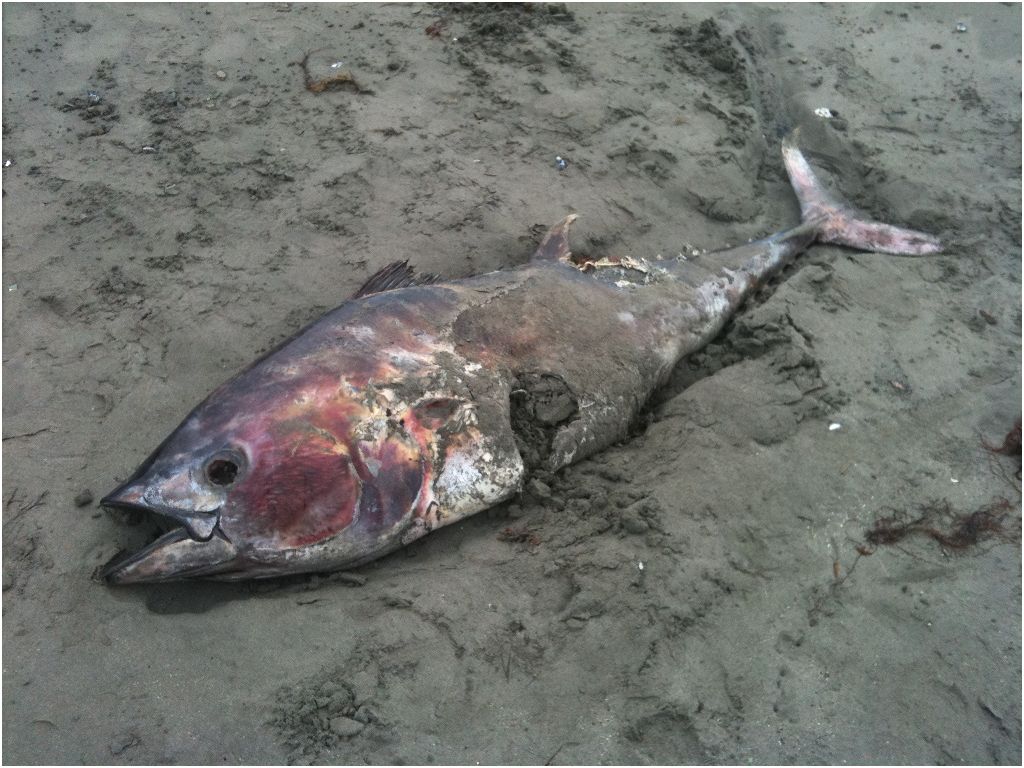
A report of a rare sighting prompted an investigation after a tuna was spotted on the shore of Laggan Sands, Isle of Mull. The Hebridean Whale and Dolphin Trust (HWDT) were notified of by the unusual find and set off for Lochbuie. Morven Summers, Volunteer Coordinator at HWDT, said, “We were a wee bit dubious at first and thought that the reporter may have mistaken a porpoise, however when we arrived at Laggan Sands we were shocked to see the huge fish on the shore.” It’s believed that the fish is a bluefin tuna; a large, torpedo-shaped fish that can travel at speeds of up to 43 miles per hour and weighs, on average, 550 lbs, although much larger specimens are not uncommon. The Mull tuna measured 1.8 metres long. Brain Swinbanks, Chairman of the Tobermory Harbour Association, added, “Seeing the fish up close was fantastic, I would guess that the ’mull tuna’ weighed about 150 lbs.”
Atlantic bluefin tuna spawn in the Mediterranean Sea, however they are highly migratory and tagged individuals have been tracked swimming from North American to European waters several times a year.
Although not many consider the waters off the west coast of Scotland to play host to such a fish, historically tuna did frequent these waters. Dr. Clive Fox, from the Scottish Association of Marine Science in Oban, explains, “Bluefin tuna are rare in our waters but not unprecedented, indeed there used to be a commercial and sport fishery for them before the war.” In fact, evidence of bluefin tuna making an annual migration to UK waters goes back a few hundred years. Brain Swinbanks, Chairman of the Tobermory Harbour Association, added, “ The British rod and line record for Blue Fin Tuna is 851lbs caught in the North Sea in 1933 by Mr Mitchell-Henry fishing from a ship’s rowing boat 50 miles off shore and alongside the Herring Fleet. A decline in the stocks of herring resulted in a decline in migratory Tuna which originally came from the Mediterranean migrating all round the west coast of Scotland.” In September 1989, a 400lbs tuna was reported caught close to the Isle of Lewis.
Unfortunately the tuna carcass was too decomposed for full analysis, however the fish’s otoliths (ear bones) will be recovered and from these the age of the fish can be determined. If you find a stranded animal, HWDT would be very interested to learn about it. If researchers reach the carcass in good time then we can learn many things about the animal and why it may have perished. Please contact HWDT on 01688 302620 or email sightings@hwdt.org if you find anything on the shore.
Thursday, 4 November 2010
Fin Whale spotted off Gairloch - HWDT
The world's second largest mammal, the Fin Whale (Balaenoptera physalusis) has been seen off the Hebrides.
For report, follow link below
Hebridean Whale and Dolphin Trust
The fin is the second largest whale and the second largest living animal after the blue whale, growing to nearly 27 meters (88 ft) long.
Long and slender, the fin whale's body is brownish-grey with a paler underside. There are at least two distinct subspecies: the Northern fin whale of the North Atlantic, and the larger Antarctic fin whale of the Southern Ocean. It is found in all the world's major oceans, from polar to tropical waters. It is absent only from waters close to the ice pack at both the north and south poles and relatively small areas of water away from the open ocean. The highest population density occurs in temperate and cool waters. Its food consists of small schooling fish, squid, and crustaceans including mysids and krill.
Like all other large whales, the fin whale was heavily hunted during the twentieth century and is an endangered species. Almost 750,000 fin whales were taken from the Southern Hemisphere alone between 1904 and 1979 and less than 3,000 currently remain in that region. The International Whaling Commission (IWC) has issued a moratorium on commercial hunting of this whale, although Iceland and Japan have resumed hunting: in 2009, Iceland took 125 fin whales during its whaling season, and Japan took 1 fin whale in its 2008-2009 Antarctic season. The species is also hunted by Greenlanders under the Aboriginal Subsistence Whaling provisions of the IWC. Collisions with ships and noise from human activity also significantly threaten recovery. (Wikipedia)
The fin is the second largest whale and the second largest living animal after the blue whale, growing to nearly 27 meters (88 ft) long.
Long and slender, the fin whale's body is brownish-grey with a paler underside. There are at least two distinct subspecies: the Northern fin whale of the North Atlantic, and the larger Antarctic fin whale of the Southern Ocean. It is found in all the world's major oceans, from polar to tropical waters. It is absent only from waters close to the ice pack at both the north and south poles and relatively small areas of water away from the open ocean. The highest population density occurs in temperate and cool waters. Its food consists of small schooling fish, squid, and crustaceans including mysids and krill.
Like all other large whales, the fin whale was heavily hunted during the twentieth century and is an endangered species. Almost 750,000 fin whales were taken from the Southern Hemisphere alone between 1904 and 1979 and less than 3,000 currently remain in that region. The International Whaling Commission (IWC) has issued a moratorium on commercial hunting of this whale, although Iceland and Japan have resumed hunting: in 2009, Iceland took 125 fin whales during its whaling season, and Japan took 1 fin whale in its 2008-2009 Antarctic season. The species is also hunted by Greenlanders under the Aboriginal Subsistence Whaling provisions of the IWC. Collisions with ships and noise from human activity also significantly threaten recovery. (Wikipedia)
Tuesday, 2 November 2010
Subscribe to:
Posts (Atom)