I found this Pale Brindled Beauty in the public toilets at Bridgend on Tuesday (15th), appropriately in the gentlemen's side of the facility as this is the male of the species. This slightly blurred photograph was taken on my iPhone. As someone has since commented, taking photographs in public toilets is something to be rather cautious about and I decided not to go back in with my camera! The female moth is distinctively different, but I had to reply "no, I didn't" when asked if I had checked for one in the ladies' side!
There are no previous records for Islay for this species, which flies between January and March, though there were three records on Jura back in 1980, which have to be regarded with suspicion as they were all in early September with no mention that they were pupae, which is the stage the moth would be in at that time of year. So this may well be the first record for the vice-county, i.e. Islay, Jura and Colonsay.
Malcolm
Friday, 18 March 2016
Thursday, 17 March 2016
New Zealand Flatworm - Islay distribution - quick poll
On the back of our next talk the irony of the world exporting its wildlife to this remote island ecosystem. New Zealamd wildlife is giving payback - the New Zealand flatworm.
The irony is that for all
the introduced species sent in their direction New Zealand has a problematic
species export of its own now increasing its distribution here. Visit the Islay Natural History Trusts
Facebook page if you have the New Zealand Flatworm in your garden and let us
know where you have seen it in our quick poll into its current distribution on Islay . It may have
been present quite a few years now but I have only recently met one on these
unpleasant creatures. Why are they important? well they like to eat our native
Earthworms that do an important job of mixing up and aerating the soil, and
provide food for a whole host of bird species.
Fiona MacG
Next Talk 22nd March - New Zealand - Ecological Mayhem!
It seems to have been a popular destination for

But New Zealand is
indeed a beautiful country when viewed from other perspectives with quaint
towns, productive green farmland, and stunningly dramatic landscapes. Happily the tide of extinctions and losses is
turning and New Zealand
has perhaps the most pro-active and drastic government conservation policies of
anywhere in the World. This has saved at least some of its very special
wildlife from the brink and, in some ways, made it surprisingly easy for
birdwatchers to see what remains.
Come along and discover
the impacts that new species can have when they don't complement the native
wildlife.
Monday, 8 February 2016
AGM and Seychelles Talk
![]() |
Join us this Tuesday 16th February at 7:00pm for a brief (we
promise!) AGM followed by what promises to be a fascinating talk by Michal Šúr
on Aldabra in the Seychelles at the INHT Centre in Port Charlotte (next to the
youth hostel). Admission is free, as is the tea and cake, although donations
are always welcome!
Michal is a fantastic photographer, so his images from Aldabra promise
to be stunning. Aldabra itself is the second largest raised atoll in the world,
and the largest in the
|
Monday, 23 November 2015
Wildlife Crime talk this Thursday 26th November
Join us this Thursday 26th November at 7:30pm for what promises to be a fascinating talk by Gary Turnbull on Wildlife Crime, at the INHT Centre in Port Charlotte (next to the youth hostel). Admission just £3 (£1 for INHT members) including tea and cake!
Thursday, 5 November 2015
All done for another season
The centre was a hive of activity on Saturday morning, finding all the creatures in the tanks and putting them back into the sea.
The tanks and sand were emptied and a good general tidy up. Great work from all our helpers.
The season has been a good one with over 1600 visitors and sales and admissions up on the previous season.
| Careful searching for every last beastie |
The tanks and sand were emptied and a good general tidy up. Great work from all our helpers.
| Fishes and crab ready for release |
| Lobster ready for the sea |
We will be back open in the Spring
Thursday, 29 October 2015
Last chance to visit the sea creatures this season
| Our monster - Edible Crab |
There is just one more day left of the season for the Islay Natural History Centre, your last chance to see the crabs, lobster and Topknot flatfish before we release them back into the wild.
We will be emptying the tanks on Saturday morning so if you can come and visit tomorrow (Friday 30th) between 10.30 - 4.30 we would love to see you.
| Don't mess with me! - Velvet swimming crab |
| 'Greedy guts' - Long-spined Seascorpion |
| Cute - Topknot flatfish |
Come see us on our last day!
Wednesday, 28 October 2015
Coast to Coast talk tomorrow evening 29th October
Join us tomorrow evening (29th Oct) for what promises to be a fascinating talk on the Coast to Coast walk by Sandy Taylor and Chris Abell - with refreshments, a picture quiz and even a prize! £3 (£1 for INHT members), 7:30pm at the INHT Visitor Centre, Port Charlotte (next to the youth hostel).
Thursday, 22 October 2015
Our Topknot flat fish
Seashell ID Workshop - this Sunday 25th October (2-4pm)
I think I may have chosen well looking at the weather - an indoor rAmble this week!
Well be sure to have a gander along a beach before hand and collect up some interesting shells and beachcombing finds of mystery and bring them along. Our seashell identification workshop this Sunday will aim to give you hints and tips on how to identify your beach treasures. There will be an array of specimens to compare against, I have collected shells from all of Islay's beaches and have amalgamated records of some 134 species so whether large or small I can help with identification.
There are some interesting stories behind some of the species and what they get up to when living.
Here are some good places to go looking:
Uiskentuie Strand - for big clam species - occasional piddocks and some smaller gastrapods
Black Rock can throw up some interesting smaller specimens, particularly after this recent storm
Big Strand, nr. Knockangle Point - the currents collect a lot of interesting species, Cowries and other sea-snails.
Kilnaughton - look for small and miniature species, and some not found regularly elsewhere
Killinallan and Ardnave - can have a whole range of different species, although you may have to walk further between finds.
Gartbreck - a whole array of medium to small sea-snails gather and wash ashore with the currents, many rarer and more fragile, so a great place for more unusual specimens.
Any west coast beach after the last days winds may throw up Goose Barnacles on floating logs and 'By-the-wind Sailors' at this time of year.
Come and join me on Sunday, only £2 for INHT members; £4 non-members
Fiona MacGillivray
There are some interesting stories behind some of the species and what they get up to when living.
Here are some good places to go looking:
Uiskentuie Strand - for big clam species - occasional piddocks and some smaller gastrapods
Black Rock can throw up some interesting smaller specimens, particularly after this recent storm
Big Strand, nr. Knockangle Point - the currents collect a lot of interesting species, Cowries and other sea-snails.
![]() |
| Pheasant Shell |
Killinallan and Ardnave - can have a whole range of different species, although you may have to walk further between finds.
Gartbreck - a whole array of medium to small sea-snails gather and wash ashore with the currents, many rarer and more fragile, so a great place for more unusual specimens.
| Goose Barnacle |
| Sea Squirt |
Come and join me on Sunday, only £2 for INHT members; £4 non-members
Fiona MacGillivray
Autumn Woodland Wonders
Autumn Woodland Wonders activity last week was a great experience, the weather perfect, the leaves all changing colour and very enthusiastic little people ready for some woodland exploration. We set out looking for all the interesting leaves, nuts and seeds, looking for all the signs of Autumn. The leaves of Sycamore just now are covered in black spots, evidence of the presence of 'Jerking Disc Sawfly'.
The children enjoyed a spell of fun on the rope swing before a game of Poo Sticks off the bridge over the River Sorn and then a hunt for minibeasts amongst the leaf litter and rotting logs.
All keen explorers.
The children enjoyed a spell of fun on the rope swing before a game of Poo Sticks off the bridge over the River Sorn and then a hunt for minibeasts amongst the leaf litter and rotting logs.
All keen explorers.
Tuesday, 20 October 2015
Islay Dolphins
Fantastic sighting of dolphins on way to work today, a pod of 8 - 10 dolphins in Loch Indaal. As I was approaching Port Charlotte lighthouse I saw several animals break the surface heading northwards close into the shore.
On continuing to watch I realised that there was a pod of dolphins spread out close to shore. Pity the film crew working at the lighthouse didn't see it they had better cameras than me.
These maybe the same animals that have been in Kilnaughton Bay for the last two evenings. This is a good pod of mixed animals with large adults, sub adults and small younger dolphins.
There have been great images on local social media pages of the dolphins in Kilnaughton Bay and surrounding area.
So keep a look out for them and enjoy the sights of these beautiful animals.
Sorry no images couldn't zoom my tablets in close enough.
Gary
Monday, 19 October 2015
Birding at Carnain yesterday
Gary led a small group of dedicated birders yesterday to see what was about the shore of Loch Indaal at Carnain.
Out on the loch were a raft of scaup, with a couple of slavonian grebes in amongst them and a couple of red throated divers nearby. Nearer in to the shore between us and Blackrock were numerous red breasted mergansers, and behind us between us and the road a kestrel was hovering. Nearby on the gorse we saw a pair of stonechat, and on the strandline several pied wagtails were trotting around. Also active on the shore was a great black backed gull which had just caught a very large starfish!
Out towards Bridgend were many barnacle geese, ringed plovers and oystercatchers, and many smaller waders that had been pushed further away by the crossing cattle making identification difficult, but there was a large flock of golden plovers over on the shore towards Bowmore that looked beautiful in the sun.
Highlight of the afternoon though was the sight of these two long-tailed ducks, looking beautiful on the calm loch.
Sightings list 18/10/2015 Carnain:
| Beautiful calm conditions |
Out towards Bridgend were many barnacle geese, ringed plovers and oystercatchers, and many smaller waders that had been pushed further away by the crossing cattle making identification difficult, but there was a large flock of golden plovers over on the shore towards Bowmore that looked beautiful in the sun.
Highlight of the afternoon though was the sight of these two long-tailed ducks, looking beautiful on the calm loch.
| Long-tailed ducks, photo by Gary Turnbull |
Mute Swan; Red Throated Diver; Great Northern Diver; Grey Heron; Cormorant; Shag; Common Gull; Herring Gull; Black headed Gull; Red breasted Merganser; Scaup 35; Eider; Mallard; Teal;
Common Scoter; Long tailed Duck 2; Slavonian Grebe; Kestrel; Curlew; Oystercatcher; Golden Plover; Ringed Plover; Bar-tailed Godwit; Turnstone; Pied Wagtail; Meadow Pipit; Goldfinch; Starling; Stonechat
Tuesday, 13 October 2015
Saligo's super geology
15 people joined us on Dave's geology walk at Saligo on Sunday, which turned out to be a fascinating and informative afternoon. Dave started off by a quick resume of basic geology including the 3 categories of rock - igneous (has cooled from molten rock), sedimentary (formed in layers) and metamorphic (changed from one form to another) - which in itself was a good start for a novice like me! We then headed down onto the beach for a closer look at the amazing rocks down there.
The rocks to the south of the beach dipped to the left (SW), the ones to the north dipped right (NE), indicating that the rock layers had folded due to compressive forces (like when continents collide). Dave taught us that a convex-upward fold is called an Anticline (like and Arch) and a convex-downward fold is called a Syncline (like a Saucer).
The rocks here were turbiditic sandstones deposited by turbidity currents in deep water, and Dave reminded us of the school experiment we might have done, filling a jam jar with water, mud and rocks, shaking it up and letting it settle. The bigger bits sink to the bottom and the fine mud setlles out slower - leaving a deposit that 'fines upward'.
Many thanks to Dave for a fascinating talk/walk, and to all those who came along!
| Throw it! THROW IT! |
The rocks to the south of the beach dipped to the left (SW), the ones to the north dipped right (NE), indicating that the rock layers had folded due to compressive forces (like when continents collide). Dave taught us that a convex-upward fold is called an Anticline (like and Arch) and a convex-downward fold is called a Syncline (like a Saucer).
The rocks here were turbiditic sandstones deposited by turbidity currents in deep water, and Dave reminded us of the school experiment we might have done, filling a jam jar with water, mud and rocks, shaking it up and letting it settle. The bigger bits sink to the bottom and the fine mud setlles out slower - leaving a deposit that 'fines upward'.
| A small anticline fold in bedded turbiditic sandstones of the Colonsay Group (deposited about 750 million years ago and folded about 470 million years ago). |
Many thanks to Dave for a fascinating talk/walk, and to all those who came along!
Thursday, 8 October 2015
A migrant moth
I caught this small, 19-mm-long, moth last night. It is a Rush Veneer Nomophila noctuella which is an annual migrant to Britain from southern Europe, sometimes in large numbers. This the first I've caught and the first on Islay since one was caught at Gruinart in July 2009. There have been 14 earlier records, 9 of them in July 1996 which must have been a good year for them.
Malcolm
Malcolm
Wednesday, 7 October 2015
Geology walk at Saligo this Sunday 11th October
Next in our series of Sunday afternoon rAmbles is a Geology walk at Saligo Bay on the 11th, and if the previous geology walks are anything to go by this should be a cracker! I love looking at the rock formations at Saligo and am looking forward to hearing, amongst other things, how they were formed and what they're called from our expert Dave Webster who'll be leading the walk. Co-author of the recently published and fascinating book "A Guide to the Geology of Islay" (available in the INHT shop, now open until end October!), Dave has a wealth of knowledge to share so this is one not to miss! Meet at the gate for 2 pm - parking is limited in this area so please park responsibly. There is a small charge for this walk of £4 for adults, £2 for INHT members, and £10 for families. Sorry no dogs. See you Sunday!
Monday, 5 October 2015
October opening!
We're pleased to say that this year we're open throughout October during weekdays, so why not come along for a visit? Lots to do and see here, including a new poster on the Drift Bottle Project, as well as the newly-moulted shell of our Velvet Swimming crab! We'll be running more rAmbles and talks too, so keep and eye for more details to follow. See you soon!
Tuesday, 29 September 2015
Butterflies
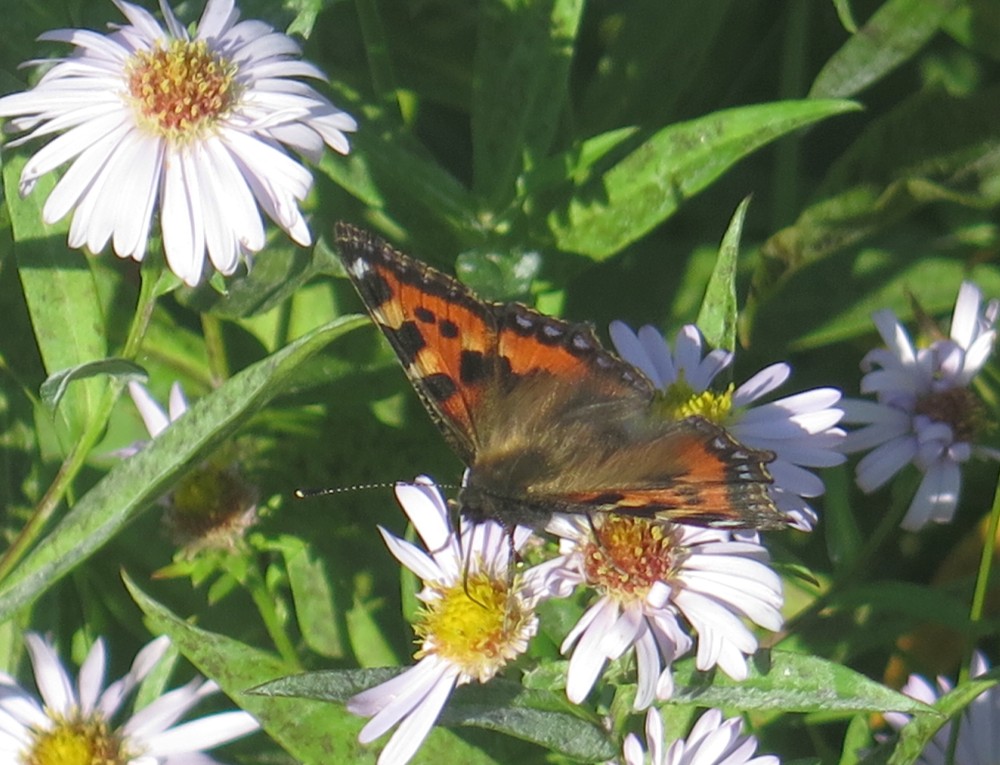
After a poor summer for butterflies in my garden - none appeared on the flowering buddleia earlier on - it was good to see three species today on the michaelmas daisies.
Malcolm
Malcolm
![]() |
| Peacock |
![]() |
| Red Admiral |
![]() | |
| Small Tortoiseshell |
Labels:
Peacock Butterfly,
Red admiral,
Small Tortoiseshell
Wednesday, 23 September 2015
A wealth of fungi waiting to be discovered...
Thanks to Alistair we found many different fungi on our INHT rAmble last Sunday at Loch Skerrols. The area itself is beautiful, with the loch looking picturesque in the calm conditions...
As you can see it looks quite spiky, which you can see in this photo too...
It often pays to look really closely at the forest floor too, and you may see something like this Stagshorn fungus (the yellow one)...
...and we headed into the woods to see what we could find.
The range of size, colours and smells of the fungi was amazing, and the more we looked the more we found, as is ever the case when looking at nature. Here's Alistair describing what he's seen to the group...
One of my favourites was Splitgill (Schizophyllum commune), the name describing how underneath the gills are split (that's what I love about mycology, there's always a clue in the name!) - I think they look like tiny white furry paws! AND it's a relatively new record for Islay so well done to Alistair for finding it.
| Splitgill (Schizophyllum commune) |
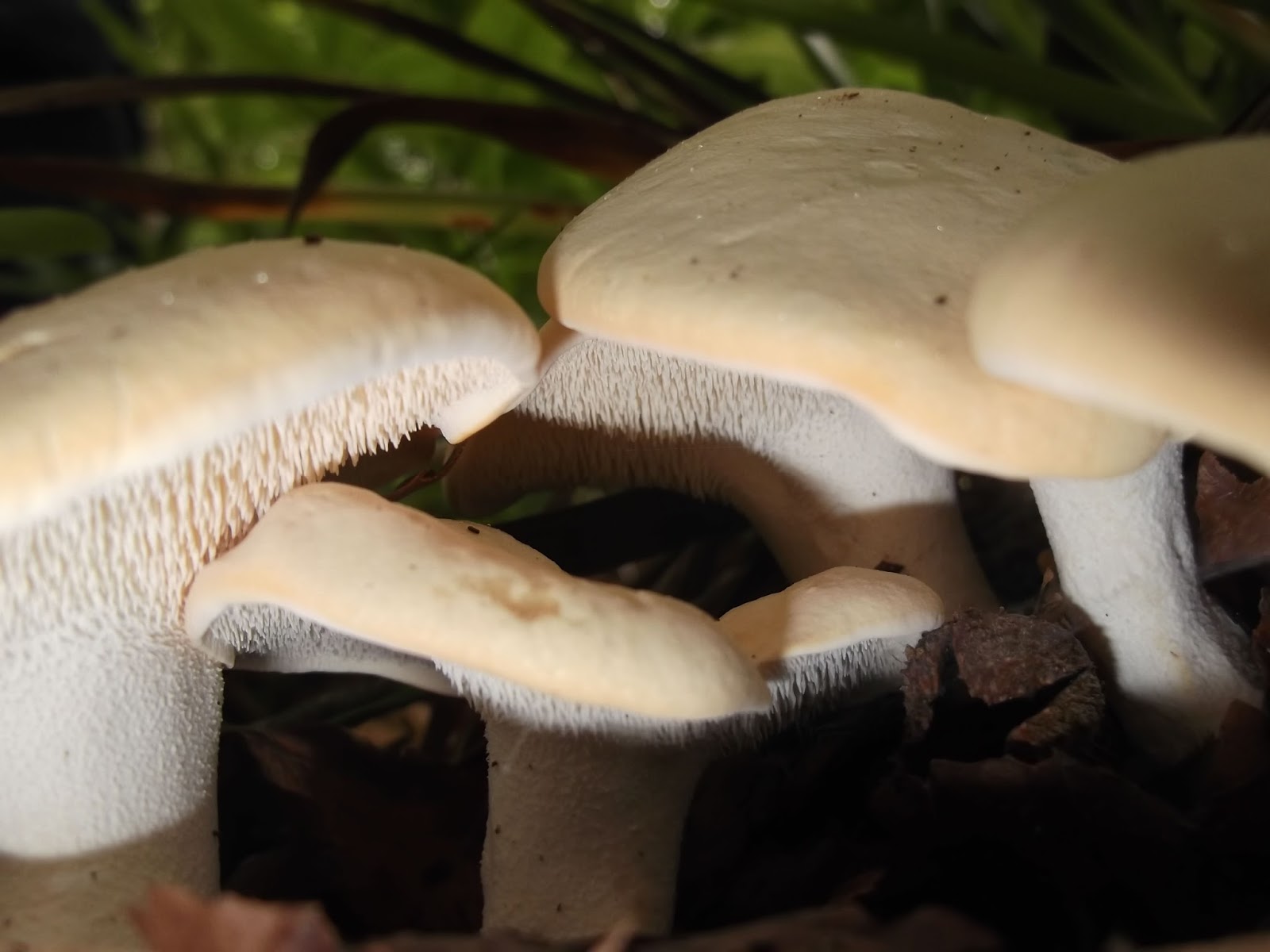
Another interesting one for me was the Wood Hedgehog (Hydnum repandum) - the fungus rather than the mammal! Again the name comes from what it looks like underneath, which is this...
| Wood Hedgehog (Hydnum repandum) |
As you can see it looks quite spiky, which you can see in this photo too...
| Wood Hedgehog (Hydnum repandum) |
I find identifying fungi quite difficult due to their changing appearance throughout their life cycle, and it seems I'm not alone, as suggested by the name of the next one, the Deceiver (Laccaria laccata), so called because it changes so much it can be mistaken for other things.
| Deceiver (Laccaria laccata) |
At least another one, the Amethyst Deceiver (Laccaria amethystina), is lilac coloured, making it a little easier to identify.
And then there was the Earthfan (Thelephora penicillata), a strange-looking fungus that forms rosette-like clusters among mosses on the forest floor. One feature of them is that however good a specimen it is, it always looks like it's been trodden on!
| Earthfan (Thelephora penicillata) |
It often pays to look really closely at the forest floor too, and you may see something like this Stagshorn fungus (the yellow one)...
| Calocera spp. |
...and this one which could be Hare's Ear (Otidea onotica).
| Hare's Ear (Otidea onotica) |
Here's a list of what we found on the day, with more photos to come no doubt! Many thanks Alistair for hisvexpertise, to Fiona for taking the photos and to everyone for their pleasant company on our fungi foray! Mandy
Fungi:
Tawny Grisette (Amanita
fulva)
Bay Bolete (Boletus
badius)
Stagshorn (Calocera spp.)
Shaggy Inkcap (Coprinus
comatus)
Webcap (Cortinarius spp)
Ganoderma (possibly Ganoderma
applanatum or Artist's Bracket)
Hoof Fungus / Tinder Bracket (Fomes fomentarius)
Common Rustgill (Gymnopilus
penetrans)
Poisonpie (Hebeloma spp)
Wood Hedgehog (Hydnum
repandum)
White Fibrecap (Inocybe
geophylla)
Laccaria spp
Amethyst Deceiver (Laccaria
amethystina)
Deceiver (Laccaria
laccata)
Mild Milkcap (Lactarius subdulcis)
Brown Birch Bolete (Leccinum
scabrum)
Bonnet (Mycena spp)
Hare's Ear (Otidea
onotica) or Tan Ear (Otidea alutacea)
Porcelain Fungus (Oudemansiella
mucida)
Deer Shield (Pluteus
cervinus)
Brittlestem (Psathyrella
spp.)
Pink Brittlegill (Russula)
Winecork Brittlegill (Russula
adusta) or Crowded Brittlegill (Russula
densifolia)
Yellow Swamp Brittlegill (Russula
claroflava)
Charcoal Burner (Russula
cyanoxantha)
Sickener (Russula
emetica)
Geranium Brittlegill (Russula
fellea)
Beechwood Sickener (Russula
nobilis)
Ochre Brittlegill (Russula
ochroleuca)
Splitgill (Schizophyllum
commune)
Urchin Earthfan (Thelephora
penicilliata)
Turkey tail (Trametes
versicolor)
Birch Knight (Tricholoma
fulvum)
Soapy Knight (Tricholoma
saponaceum)
Velvet Bolete (Suillus
variegatus)
Thursday, 17 September 2015
A Fun Fungal Foray! Join us this Sunday at Loch Skerrols
This Sunday we're running our next rAmble at Loch Skerrols near Bridgend, to see what different kinds of fungi we can find! If last year's rAmble is anything to go by, we should be in for an interesting afternoon - see here for last year's posts.
http://islaynaturalhistory.blogspot.co.uk/2014/09/finding-fungi-was-fun_9.html
http://islaynaturalhistory.blogspot.co.uk/2014/09/more-photos-from-sundays-ramble.html
If you fancy coming along, meet us at 2 pm beside Loch Skerrols. There is a small charge for this walk: £4 adults, £2 INHT members, £10 families. Sorry no dogs. See you Sunday!
Subscribe to:
Posts (Atom)